
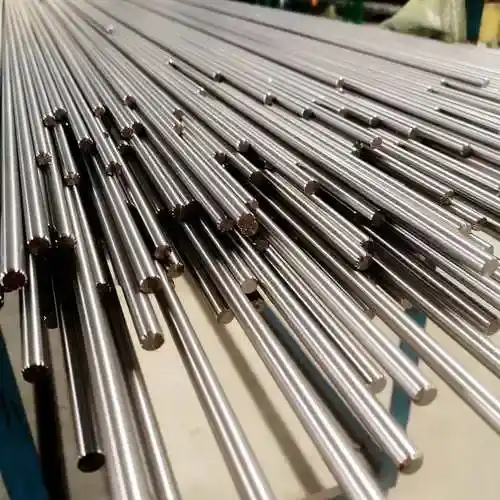
Many industries use Titanium Grade 2 (commercially pure titanium), which is strong, easy to shape, and breaks down slowly. Titanium Grade 2's properties and performance depend on its chemical makeup. This titanium grade is pure due to its low alloying. Natural titanium makes up over 99% of the material. The rest is made up of iron, carbon, oxygen, nitrogen, hydrogen, and other elements in carefully controlled amounts. Even though they are only present in small amounts, these trace elements have. To decide if Titanium Grade 2 is good for a project and how to improve its performance, engineers, makers, and end-users must know its composition.
What are the key properties of Titanium Grade 2?
Lifetime and Mechanical Toughness
A lot of people use Titanium Grade 2 for many different things because it has great mechanical properties. It has a high strength-to-weight ratio since it's stronger than most other materials with a high strength-to-weight ratio and low density. This type of titanium can have a yield strength of anywhere from 275 to 450 MPa, depending on how it was made. Titanium grade 2 can hold a lot of weight since its ultimate tensile strength is between 345 and 550 MPa. Plus, it can be stretched about 20% more than its original length after it breaks, which shows that it can be easily shaped into different forms. Because of these qualities, Titanium Grade 2 is a good material for uses that need a lot of strength, a light build, and the ability to handle a lot of stress without breaking. Topak makes some of the best titanium products. With these skills, they make durable, functional parts for a variety of fields.
Rust-free steel
One of the things that makes Titanium Grade 2 special is how well it resists corrosion. This material can form an oxide film on its surface when it is close to oxygen. The film is stable, continuous, and hard to remove. In a wide range of situations, this layer, which is mostly titanium dioxide (TiO2), keeps Titanium Grade 2 from corroding. Seawater, oxidizing acids, chlorides, and a lot of other strong chemicals are very unlikely to hurt it. Titanium Grade 2 is a good metal to use in chemical processing plants, marine settings, and other places where corrosion is likely to happen because it doesn't corrode easily. Topak's Grade 2 Titanium has been used a lot in projects where corrosion needs to be avoided. This proves that the material can withstand tough conditions over time and still do its job well.
How it handles heat and how simple it is to weld it
Because of how it reacts to heat, Titanium Grade 2 can be used in a lot of different ways. Compared to most metals, it is a bad heat conductor. This property can be useful in keeping things from getting too hot in some cases. The substance stays strong even when it's hot because it doesn't melt until about 1660°C (3020°F). Titanium Grade 2 is also a good metal to weld, so it can be used in fabrication processes that need to be able to weld parts together. Since it has a low thermal expansion coefficient, it won't bend a lot when it is heated or welded and cooled. Titanium Grade 2 is a good metal for pressure vessels and heat exchangers that need to be able to handle welding or heat because of these properties. Topak has worked with Titanium Grade 2 a lot. Because of this, anyone can be given the best parts by using these thermal and welding traits.
How does the chemical composition affect the performance of Titanium Grade 2?
Impact of Additives in Metals
The performance of Titanium Grade 2 depends a lot on its chemical makeup. It is commercially pure titanium, but the small amounts of other metals in it change how it acts in a big way. Iron usually makes up less than 0.30% of the material, but it helps make it stronger and refine the grain. Oxygen, which can only make up 0.25% of the material, works as an interstitial strengthening element. It makes the material stronger, but could also make it less ductile if there is too much of it. With a maximum content of 0.08%, carbon also makes the metal stronger, but it must be carefully controlled to maintain weldability. Nitrogen can make things stronger, but if it's present in more than 0.03%, it can make them more brittle. Hydrogen must be kept at just 0.015% of the total to stop hydrogen embrittlement. Topak's strict quality control checks make sure that their Titanium Grade 2 products work well in a range of situations by using the right mix of chemicals.
Effects on Mechanical Properties
The way Titanium Grade 2 is made affects its mechanical properties, which in turn affect its strength, hardness, and ductility. The good ductility and overall strength of the material are due to the careful balance of the elements that make up the alloy. For example, controlled solid solution strengthening mechanisms show that oxygen and nitrogen make the material stronger. But too much of these elements can make the material brittle and harder to shape. The iron helps with grain refinement, which can make things stronger and tougher. The low carbon content makes it easy to weld without losing strength. The yield strength, ultimate tensile strength, and elongation properties of a material are all determined by these compositional factors. Topak uses its knowledge of these composition-property relationships to make Titanium Grade 2 parts with the best mechanical properties for each specific application.
Effect on the Ability to Resist Corrosion
Because of its composition, titanium Grade 2 resists corrosion better than most metals. The surface is protected by a stable oxide layer because titanium is usually over 99% pure. This passive film protects against corrosion with mostly titanium dioxide. Metal becomes more corrosion-resistant when these elements are added in controlled amounts. In chloride-rich areas, low iron levels stabilize the passive film. Oxygen deficiency stabilizes oxide. However, high levels of impurities like carbon or nitrogen may weaken the passive film, making corrosion easier in certain conditions. Topak's strict quality control checks optimize Titanium Grade 2 products' chemical makeup to resist corrosion in underwater and chemical processing applications.
What are the main applications of Titanium Grade 2?
Industrial and Chemical Processing
Chemical companies and factories use titanium Grade 2 because of its corrosion resistance and mechanical properties. It is used to make reaction vessels, heat exchangers, and piping systems for metal-eating chemicals in chemical plants. This material can handle many acids, bases, and chlorides, making it ideal for harsh environments. Titanium Grade 2 is used for pulp and paper bleaching equipment and other chemical-exposed parts. It doesn't crack in chloride-rich environments, making it ideal for desalination plants and offshore oil and gas facilities. Topak's Titanium Grade 2 products have been used in many industrial projects and are reliable and durable even in harsh chemical conditions.
For marine and offshore use
Titanium Grade 2 is widely used in marine and offshore industries because it resists seawater corrosion. Ship and offshore platform heat exchangers, condensers, and piping systems are made from it. This material is ideal for marine propeller shafts and other lightweight parts due to its high strength-to-weight ratio. Titanium Grade 2 is used for risers, equipment below sea level, and parts exposed to seawater and well fluids that can damage materials in offshore oil and gas drilling. When chlorides are abundant, it doesn't corrode easily in crevices or pits, so it lasts longer. Topak supplies Grade 2 titanium for marine and offshore projects. These have improved performance and reduced maintenance in tough environments.
Health care and biomedical
Because it is biocompatible, corrosion-resistant, and mechanically strong, Titanium Grade 2 has become very important in healthcare and biomedical fields. It's very common to use it when making medical implants like screws, bone plates, and dental implants. The material is great for orthopedic and dental uses because it can osseointegrate, or bond directly with bone tissue. Besides implants, Titanium Grade 2 is also used to make surgical tools, parts for medical devices, and equipment for making pharmaceuticals. It is very resistant to bodily fluids and sterilization processes, which makes it a good choice for medical uses that need to last. Topak's Titanium Grade 2 products have been used in a range of medical devices. These products have helped make progress in both patient care and medical technology. Since it doesn't conduct heat well, the material is also good for prosthetic parts because it keeps the heat from affecting the tissues around it.
Conclusion
Chemicals make Titanium Grade 2 hard to replace. perfectly balanced, giving it unique properties.d in manyused in chemical processing, marine applications, and biomedical fields because it resists corrosion, has a high strength-to-weight ratio, and is compatible with living tissue. The effect of its chemical makeup on its mechanical properties and ability to resist corrosion shows how impIn manufacturing. Titanium Grade 2 is used to make versatile, reliable, and long-lasting products. Engineers and manufacturers are always looking for better materials.
LINHUI TITANIUM is a top maker and supplier of titanium and titanium alloys. It was started in 2000 and is based in Xi'an, China. LINHUI TITANIUM follows the development strategy of "supplying high-end products, establishing a world-renowned enterprise." They are committed to making things better for their customers. We offer excellent service and high-quality products to customers around the world with our wide selection of titanium goods, including Grade 2 titanium. We have worked with famous businesses from over 60 countries and areas, successfully exporting our products. ISO 9001:2015 and OHSAS 18001:2007 are two of the many certifications we have that show our commitment to quality and reliability. Major inspection agencies also approve our work. If you have questions or want more information, please email us at linhui@lhtitanium.com.
FAQ
The main difference between Titanium Grade 1 and Grade 2?
Due to increased oxygen content, titanium Grade 2 is stronger than Grade 1 and corrosion-resistant.
Welding Titanium Grade 2: easy?
Titanium Grade 2 is suitable for many fabrication processes due to its excellent weldability.
Does Titanium Grade 2 work for marine applications?
Absolutely. Excellent seawater corrosion resistance makes it ideal for marine and offshore applications.
How does Titanium Grade 2's chemical composition affect strength?
Controlled amounts of alloying elements like oxygen and iron strengthen the material through various mechanisms.
Why does biomedicine prefer Titanium Grade 2?
Biocompatibility, corrosion resistance, and osseointegration make it ideal for medical implants and devices.
References
1. ASM International. (2015). Titanium: A Technical Guide. Materials Park, OH: ASM International.
2. Leyens, C., & Peters, M. (Eds.). (2003). Titanium and Titanium Alloys: Fundamentals and Applications. Weinheim: Wiley-VCH.
3. Donachie, M. J. (2000). Titanium: A Technical Guide (2nd ed.). Materials Park, OH: ASM International.
4. Lütjering, G., & Williams, J. C. (2007). Titanium (2nd ed.). Berlin: Springer-Verlag.
5. Boyer, R., Welsch, G., & Collings, E. W. (Eds.). (1994). Materials Properties Handbook: Titanium Alloys. Materials Park, OH: ASM International.
6. Peters, M., Hemptenmacher, J., Kumpfert, J., & Leyens, C. (2003). Structure and Properties of Titanium and Titanium Alloys. In C. Leyens & M. Peters (Eds.), Titanium and Titanium Alloys: Fundamentals and Applications (pp. 1-36). Weinheim: Wiley-VCH.