
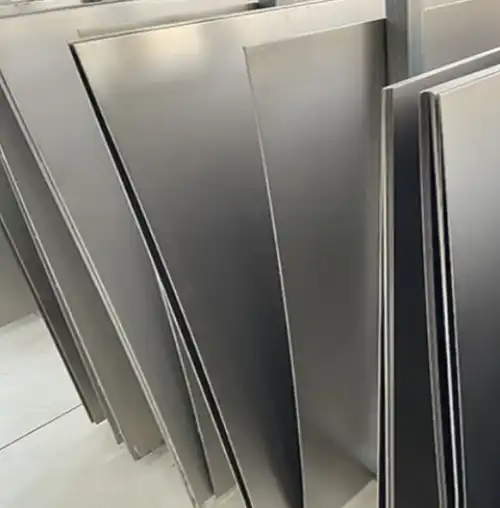
Rolling 6Al-4V titanium sheet is a controlled process that 6al4v titanium sheet takes titanium billets and turns them into precision-engineered sheets by using hot and cold shaping methods one after the other. This alloy is made up of 90% titanium, 6% aluminum, and 4% vanadium. It needs to be carefully controlled at high temperatures—usually hot rolled between 850°C and 980°C to get the best grain refinement—and then cold rolled at room temperature to get exact dimensions and a better surface. The rolling process has a direct effect on the mechanical properties of the sheet. This determines whether the 6Al-4V titanium sheet will meet the strict aerospace AMS 4911 standards or work reliably in harsh offshore drilling settings.
Understanding 6Al-4V Titanium Sheet: Properties and Specifications
The 6Al-4V mix makes an alpha-beta titanium alloy that has a density of 4.43 g/cm³, which is about 60% of structural steel, and a tensile strength of more than 895 MPa when it is heated. The aluminum stabilizes the alpha phase, which makes it more resistant to creep and oxidation. The vanadium stabilizes the beta phase, which makes it easier to harden and stronger after heat treatment. These qualities, on the other hand, can only be achieved by rolling the material very carefully.
Core Mechanical Characteristics
The tensile strength of an annealed 6Al-4V titanium sheet is usually between 895 and 930 MPa, the yield strength is around 828 MPa, and the stretch is between 10 and 15%. The material stays structurally sound at temperatures up to 400°C, which means it can be used for a wide range of things, from jet engine parts to equipment on ocean platforms that are exposed to changing temperatures. The hardness ranges from 30 to 36 HRC, based on how the metal was heated.
Dimensional Standards and Tolerances
Specifications for the industry set very specific rules for making sheets. Thicknesses range from 0.5 mm foils used to make medical devices to 100 mm or more heavy plates used to build pressure vessels. Standard lengths range from 500mm to 2000mm, but custom sizes can be made for certain uses. ASTM B265 specifies the width limits that are acceptable. For sheets less than 3 mm thick, these are usually ±0.10 mm. This makes sure that the sheets can be used with the right tools and meet the requirements for assembly.
Certification Requirements
In controlled businesses, being able to track materials is a must. Aerospace uses need to follow AMS 4911, and medical implant makers need ISO 5832-3 approval to show that the materials are biocompatible. For oil and gas projects, ASTM B265 compliance is required, along with proof from a third-party review. Each certification comes from controlled rolling methods that make sure the mechanical qualities and chemical makeup can be checked.
The Rolling Process of 6Al-4V Titanium Sheet: Step-by-Step Breakdown
At every step of the process, precise metallurgical control is needed to make sure that the titanium sheets are of good quality. Through carefully planned thermal and mechanical steps, the rolling process turns billets that were cast or formed into precise sheets. Each step affects the dependability of the final product, which is why trusted makers spend money on advanced rolling infrastructure and process controls.
Billet Preparation and Chemical Verification
The process starts with evaluating the raw materials. Spectroscopic analysis is used to make sure that the ingots' chemical makeup is within the allowed ranges of 6.0% aluminum (±0.5%), 4.0% vanadium (±0.5%), and controlled intermediate elements such as oxygen (maximum 0.20%) and iron (maximum 0.30%). Chemical regularity stops weak spots from forming in certain places that could weaken the structure while it's being used. Then, the billets are scalped to get rid of any dirt or 6Al-4V titanium sheet debris on the surface and cut to the right size for the mill.
Hot Rolling: Temperature-Controlled Deformation
The main step in the lowering process is hot rolling. In special ovens, billets are cooked to temperatures between 850°C and 980°C. This puts them in the beta phase field, which makes titanium more flexible. Controlling the temperature is very important. Too much heat makes the grains bigger and forms alpha cases, while not enough temperature raises the rolling loads and causes cracks. The hot block goes through several rolling mill stands, where its thickness is gradually reduced. In modern mills, the material is moved back and forth through the work rolls while the gap sets are gradually made smaller. Each pass causes localized distortion, which smooths out the grain structure and evenly distributes the alloying elements. During normal hot rolling, the width is reduced by 70–85%, turning a 200mm billet into a middle gauge of about 3–6mm.
Cold Rolling: Precision and Surface Excellence
The surface finish and precision of the dimensions are improved by cold rolling. This process works at room temperature and uses lighter reduction passes (10–30% per pass) to get thickness tolerances of ±0.05mm or better. Through strain hardening, cold working also makes things harder, but they need to be heated afterward. The cold rolling process raises the quality of the surface to mill finish standards, gets rid of small surface flaws caused by hot rolling, and makes the thickness regularity needed for pressure vessels and aircraft skin panels. Putting things through planetary or cluster mills more than once lowers the thickness while keeping the flatness requirements.
Intermediate Annealing: Stress Relief and Recrystallization
Sheets go through annealing processes at 700–790°C in controlled atmosphere or vacuum ovens in between rolling steps. Annealing does several things: it reduces leftover stresses that could lead to warping during manufacturing; it encourages recrystallization, which improves grain structure; and it brings back the ductility that was lost during cold working. Controlling the gas during annealing keeps oxygen from picking up, which would weaken the top layer. The annealing plan, which includes the time at temperature and the rate of cooling, is perfectly set to get the desired mechanical qualities. For uses that need better performance, solution treatment and aging (STA) can make the material even stronger.
Final Processing and Quality Verification
When sheets are finished, they are carefully looked over. Ultrasonic testing finds breaks inside the material, measuring its thickness and flatness makes sure it's the right way, and mechanical testing makes sure its tensile strength, hardness, and flexibility meet the requirements. A surface check finds any problems that need to be fixed. By combining thermal processing with mechanical deformation in this all-encompassing rolling method, 6Al-4V titanium sheets are made that have the uniform qualities needed for important uses.
Comparison of 6Al-4V Titanium Sheet with Other Forms and Materials
To choose the best titanium product shape and grade, you need to know how performance changes depending on the purpose. Knowing these differences between materials lets you make smart design choices, matching the material's abilities to the needs of the application while maximizing cost-performance ratios.
Sheet versus Plate and Bar Configurations
6Al-4V comes in a number of different forms, each of which is best for a different type of production. Sheets, which are usually described as materials that are less than 5 mm thick, are very easy to shape for stamping, bending, and welding, all of which are common tasks in aircraft assembly and heat exchanger manufacturing. Plates with thicknesses from 5 mm to over 100 mm provide solid mass for use in pressure tanks and ballistic defense. Bars and forgings are good for parts that need to be strong in more than one way, like landing gear struts and engine shafts. Sheets are useful in situations where weight is important because they let you reduce the width without lowering the power. Their large surface area makes it easier for chemical processing equipment to move heat efficiently and makes it cheaper to use CNC to cut shapes with complicated shapes.
Ti-6Al-4V versus Commercially Pure Titanium Grades
Commercially pure (CP) titanium grades (Grades 1-4) are very good at resisting rust and being welded, but they are not as strong. For example, Grade 2's tensile strength is only about 345 MPa, which is less than 40% of what 6Al-4V can do. For pipes under the sea that are used in sour conditions, CP grades may be enough if the pressure rates are low. But underwater drilling shafts, aircraft structures, and high-speed rotating parts need the extra strength that only alloyed types can provide. The difference in strength directly leads to less weight and better efficiency. A wing spar made from Grade 5 sheet is 40% lighter than one made from Grade 2 sheet of the same load capacity.
Ti-6Al-4V versus Stainless Steel
When compared to grades of stainless steel like 316L, 6Al-4V has clear benefits in harsh settings where corrosion is a problem. While 316L is generally resistant to rust, titanium metal stays strong in chloride-rich environments where stainless steel breaks down in pits and crevices. For example, titanium heat exchangers in desalination plants and offshore platforms don't need to be maintained for decades, while stainless steel versions need to be replaced often. When you compare weights, titanium is even better. A heat exchanger made from a titanium alloy sheet weighs about 60% less than one made of stainless steel.
The Rolling Process Impact on Material Selection
The quality of rolling directly affects the usefulness of the 6Al-4V titanium sheet. The dynamic properties of precisely rolled sheets with controlled grain structure can be predicted, which is important for engineering estimates and figuring out the safety factor. When rolling isn't handled well, properties change, which means that designers have to be careful, which takes away from the material's benefits. Rolling process control is proven by certifications. For aircraft uses, AMS standards need proof of the material's thermal history, reduction plans, and heat treatment parameters. This makes sure that every sheet fits strict property requirements.
Procurement Insights: How to Buy 6Al-4V Titanium Sheet with Confidence
To successfully buy titanium, you need to know how to deal with technical specs, supplier skills, and business terms in order to get material that meets performance standards while staying on budget and on plan for the project. By following these rules for buying things, you can lower your risk, make sure the items you buy are right for the job, and build relationships with suppliers that will help your project succeed.
Defining Technical Requirements
Creating clear specifications is the first step in the procurement process. In addition to basic measurements like thickness, width, and length, buyers must also define the surface finish (mill finish, pickled, or polished), the tolerance class, the heat treatment condition (annealed or STA), and the standards that apply (ASTM B265, AMS 4911, ISO 5832-3). Custom needs like edge preparation, CNC cutting patterns, or specialized tests increase value but change price and wait time. Understanding the important features of your program helps you make accurate specifications.
Evaluating Supplier Qualifications
How reliable the materials are and how stable the supply chain is depend on which suppliers are chosen. Manufacturers that are qualified keep a full set of certifications, such as ISO 9001 for quality management, PED 2014/68/EU for pressure equipment, ASME Section X nuclear certifications, and approvals from classification societies (DNV, ABS, Lloyd's Register). These approvals show that quality systems and process standards are working properly. An evaluation of a company's manufacturing capabilities should look at its rolling mill equipment, its own testing labs, its heat treatment facilities, and its systems for keeping track of materials.
Navigating Pricing and Lead Times
The price of 6Al-4V titanium sheets depends on several factors, including the cost of the raw materials (which is determined by the prices of sponge titanium and master alloy), the difficulty of the production process (which includes standards for thickness tolerances and surface finish), the cost of certification, and the number of sheets that are ordered. Standard sizes from stock usually ship within one to two weeks. Custom rolling jobs, on the other hand, take eight to twelve weeks, based on the mill's schedule and the number of heat treatment cycles. Volume negotiations can unlock better price arrangements.
Establishing Long-Term Partnerships
When you work with strategic providers, they become an extension of your operations and tech teams. In addition to providing materials, value-added services include expert advice on choosing the right materials, processing suggestions for fabrication operations, and quick help during the project's completion. Suppliers that can handle global transportation make sure that projects all over the world get their supplies on time, which is very important for international EPC projects. Communicating regularly with suppliers about expected demand and quality standards makes relationships stronger.
Verification and Quality Control
When material is received, checking steps are taken. Dimensional checking makes sure that the length, width, and thickness meet the requirements of the buy order. Surface flaws can be seen with the naked eye. The MTR study confirms that the chemical makeup and mechanical qualities are within the ranges that were set. Extra tests, like checking the hardness, looking at the microstructure, or testing for rust, give more confidence in important uses. Setting clear acceptance standards and processes for non-conformance protects everyone.
Quality Assurance and Future Trends in 6Al-4V Titanium Sheet Rolling
New production methods and quality assurance processes are always improving the capabilities of rolled titanium sheet, making it more reliable and able to meet the changing needs of the industry. These quality systems and improvements in technology make sure that rolled titanium sheets keep meeting the needs of applications that are getting more complicated while also supporting production methods that are efficient and environmentally friendly.
Testing Standards and Certification Frameworks
Rolls of paper go through a lot of tests that are in line with international standards. ASTM B265 lists the standards for tensile tests, the maximum amount of chemicals that can be present, and the allowed differences in size. AMS 4911 adds standards for aircraft applications, such as high-cycle fatigue performance, fracture toughness, and strict non-destructive testing methods. Medical-grade materials must be tested for biocompatibility and must meet stricter cleanliness standards set by ISO 5832-3. Third-party inspection companies like DNV, Bureau Veritas, SGS, TUV, and Lloyd's Register offer independent checks for customers who want extra peace of mind.
Advanced Rolling Technologies
The standard of rolled products keeps getting better thanks to new ways of making them. Computer-controlled rolling mills with automatic gauge control systems keep the thickness uniformity within microns. This increases the output of the material and lowers the amount of waste that the customer has to deal with during production. Monitoring the temperature in real time during hot rolling makes sure that the temperature past is uniform, which results in consistent grain structure and mechanical qualities. Digitally integrated quality systems link rolling factors to the features of the finished product, letting you control the process statistically and plan for future maintenance.
Sustainability and Environmental Considerations
Environmental duty is having a bigger effect on the 6Al-4V titanium sheet, on how things are made. Titanium is naturally recyclable, which means that trash can be melted down and used again without losing any of its properties. This supports the ideas of the cycle economy. Modern mills use closed-loop water cooling systems, furnaces that use less energy, and scrap recycling programs to leave as little of an impact on the earth as possible. Life cycle research shows that titanium is more durable in harsh environments, reducing replacement frequency and total cost of ownership.
Supply Chain Resilience Strategies
Problems in the global supply chain show how important it is to have a variety of buying methods. Titanium sponge production is concentrated in certain areas, which could make them vulnerable. Strategic inventory management, which means keeping backup amounts of important sizes and specs, protects projects from supply problems. Partnerships with makers who keep large stocks of raw materials and production capacity provide supply security. Suppliers whose operations are fully integrated are more reliable when the market is unstable.
Future Development Directions
For specific uses, additive manufacturing works with rolling to make complicated shapes that aren't possible with standard fabrication. Hybrid methods, which combine rolled sheet with carefully added features, make the best use of materials and improve the speed of production. As work on alloys continues, updated 6Al-4V mixtures are being made that have better qualities for certain uses. Lower intermediate grades make the material more flexible for tough shaping jobs, while higher strength versions are used for next-generation aircraft structures.
Conclusion
The rolling of 6Al-4V titanium sheet is a complicated metallurgical process where precise control of temperature, deformation timing, and heat treatment decides the end qualities of the material. By understanding this manufacturing process, procurement professionals, engineers, and original equipment manufacturers (OEMs) can choose the right materials, assess the skills of suppliers, and form relationships that will help the project succeed. Premium suppliers are different from basic suppliers because they have quality certificates, thorough testing, and clear records of where the goods came from. As businesses look for better performance, lighter structures, and longer service lives in corrosive environments, properly rolled Grade 5 titanium sheet provides the mechanical reliability and chemical resistance that critical applications need, justifying the investment through better operational performance and lifecycle economics.
FAQ
1. What makes Ti-6Al-4V superior to commercially pure titanium grades?
The tensile strength of Grade 5 alloy is about 2.5 times that of Grade 2, a widely pure titanium, at 895 MPa compared to 345 MPa. It also has great rust resistance. Because of this strength edge, buildings in space, tools used in the ocean, and pressure vessels can be made thinner and lighter. The alloying elements also make the steel more stable at high temperatures up to 400°C, which is below the point at which pure grades stop being strong. The improved properties that alloying offers are very useful for applications that need structural efficiency in high-stress or weight-critical settings.
2. How does the rolling process affect biocompatibility for medical applications?
Controlled rolling changes the surface chemicals and texture, which are both important for biocompatibility. When material is properly treated and meets ISO 5832-3 standards, it has a regular grain structure and little surface contamination. The rolling schedule changes leftover stress states that might have an effect on how well implants work in terms of tiredness. To make sure that medical-grade materials are always biocompatible, they must go through strict process controls that include a recorded thermal history, a certified chemical makeup, and confirmed mechanical properties. Controlling the atmosphere during annealing stops oxygen from picking up on the surface, which could damage qualities that are important for osseointegration and tissue reaction.
3. What certifications should I verify when evaluating titanium sheet suppliers?
The most important licenses are ISO 9001 for quality management, which shows that the process is controlled in a planned way, and product-specific standards like ASTM B265 or AMS 4911, which show that the materials are compatible. PED 2014/68/EU certification is needed for uses that use pressure tools. For marine and offshore projects, approvals from classification societies like DNV, ABS, and Lloyd's Register are important. Medical providers need to have ISO 13485 and show that they follow ISO 5832-3. Ask for proof of approvals from third-party inspection agencies (such as TÜV, Bureau Veritas, or SGS) that show independent quality checks. Full certification files show proven quality systems and manufacturing skills.
Partner with LINHUI TITANIUM for Certified Ti-6Al-4V Sheet Supply
For medical uses, LINHUI TITANIUM makes aerospace-grade 6Al-4V titanium sheet that meets the strictest international standards, such as ASTM B265, AMS 4911, and ISO 5832-3. Our advanced rolling facilities in Xi'an make steel that has been tested and proven to have mechanical qualities like tensile strength over 895 MPa, exact thickness tolerances of ±0.05mm, and full Mill Test Reports with EN 10204 3.1 certification that show the material's provenance. We keep a large stock of foils and plates with thicknesses ranging from 0.5 mm to 100 mm or more, so we can quickly ship to project sites in North America, the Gulf region, Southeast Asia, and other places. CEFC, PTT, PDVSA, PETROECUADOR, and other world-class energy companies are among our clients. They rely on our material stability for important offshore platforms, chemical processing equipment, and aerospace structures. Contact our expert team at linhui@lhtitanium.com for detailed quotes, help with custom sizes, and quick responses from a reputable 6Al-4V titanium sheet provider dedicated to the success of your project through certified quality and on-time delivery.
References
1. Donachie, M.J. (2000). Titanium: A Technical Guide, 2nd Edition. Materials Park, OH: ASM International.
2. Lütjering, G. & Williams, J.C. (2007). Titanium, 2nd Edition: Engineering Materials and Processes. Berlin: Springer-Verlag.
3. Boyer, R., Welsch, G. & Collings, E.W. (1994). Materials Properties Handbook: Titanium Alloys. Materials Park, OH: ASM International.
4. Froes, F.H. (2015). Titanium: Physical Metallurgy, Processing, and Applications. Materials Park, OH: ASM International.
5. Peters, M., Kumpfert, J., Ward, C.H. & Leyens, C. (2003). Titanium Alloys for Aerospace Applications. Advanced Engineering Materials, 5(6), 419-427.
6. Veiga, C., Davim, J.P. & Loureiro, A.J.R. (2012). Properties and Applications of Titanium Alloys: A Brief Review. Reviews on Advanced Materials Science, 32(2), 133-148.