
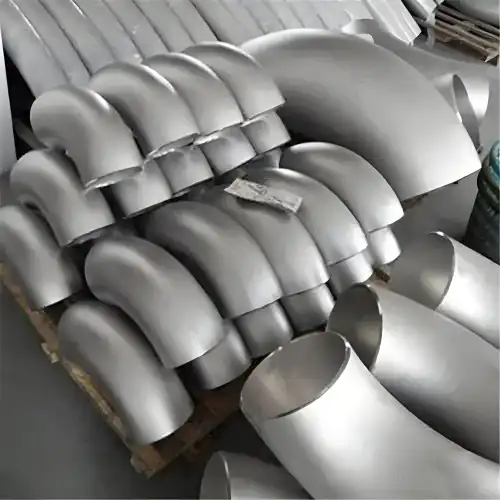
When it comes to high-stress cases that need the most strength and durability, Grade 5 titanium elbows that meet ASTM B363 standards are definitely the better choice. ASTM B363 Gr5 Titanium Elbow has a tensile strength of 895 MPa, while Grade 2 only has a 345 MPa strength. For high-pressure chemical handling systems, offshore oil platforms, and aircraft uses where efficiency can't be sacrificed, this makes it a must.
Understanding ASTM B363 Titanium Elbow Specifications
ASTM B363 sets complete standards for titanium and titanium alloy pipe parts used in high-temperature and corrosion-resistant situations. This standard covers titanium fittings that are either smooth or welded. It includes 45° and 90° elbows, tees, reducers, and caps that are made for butt-welding connections. The standard covers pressure ranges from 150# to 2500#, and sizes range from DN15 to DN600 (NPS 1/2" to 24"). Levels that are often seen are WPT1 (Level 1), WPT2 (Level 2), WPT3 (Level 3), WPT7 (Level 7), WPT9 (Level 9), WPT12 (Level 12), and WPT23 (Level 23).To make sure they meet international safety standards, these titanium tube parts go through a lot of tests. Specific chemical makeup limits, mechanical property standards, and physical tolerances are spelled out in the design to ensure stable performance in a wide range of industrial settings. Strict quality control rules must be followed during the manufacturing process. These rules include non-destructive testing methods like ultrasound checking and X-ray examination. These rules make sure that every titanium elbow pipe connection meets the high standards needed in important situations.
Grade 2 Titanium Elbow: The Workhorse Solution
Grade 2 titanium represents the most widely used commercially pure titanium grade, offering an optimal balance of properties for general industrial applications. This aerospace-grade titanium elbow provides excellent corrosion resistance while maintaining good formability and weldability characteristics.
Key properties of Grade 2 titanium elbows include:
- Tensile strength: 345-450 MPa (50-65 ksi)
- Yield strength: 275-380 MPa (40-55 ksi)
- Elongation: 20% minimum
- Density: 4.51 g/cm³
- Operating temperature range: -269°C to 315°C
Grade 2 titanium elbows are very light, which makes them perfect for chemical processing equipment, naval uses, and building projects that need modest strength but also need to be very resistant to rust. Complex shapes and unique titanium elbow configurations are possible because of how flexible manufacturing is. The material is great for making tight-radius bends without affecting its structural stability, which makes it perfect for pipe systems that don't have a lot of room. If you need reliable performance in slightly acidic settings with middling pressure needs, Grade 2 titanium elbows are a cheap option that won't compromise quality or durability.
Grade 5 Titanium Elbow: The High-Performance Champion
Grade 5 titanium (Ti-6Al-4V) stands as the most versatile and widely used titanium alloy, delivering exceptional strength-to-weight ratios that surpass many steel alternatives. This ASTM B363 Gr5 Titanium Elbow high-strength titanium elbow contains 6% aluminum and 4% vanadium, creating a material ideally suited for demanding aerospace and industrial applications.
Superior mechanical properties of Grade 5 titanium elbows include:
- Tensile strength: 895-930 MPa (130-135 ksi)
- Yield strength: 825-870 MPa (120-126 ksi)
- Elongation: 10% minimum
- Density: 4.43 g/cm³
- Operating temperature range: -269°C to 400°C
The improved strength properties allow for smaller wall sections while keeping the pressure values the same. This saves a lot of weight in aircraft and car use. The ability to heat treat materials lets them have better properties through melting or aging processes. For Grade 5 titanium elbow welding, you need to use special methods because the metal is easily contaminated. Controlled cooling rates and the right amount of shielding gas covering protect the weld and keep the base material's mechanical properties. For important uses that need the highest level of strength in high-stress areas with high temperatures, Grade 5 titanium elbows offer unmatched dependability and durability.
Comprehensive Performance Comparison
Direct comparison reveals significant differences between these titanium alloy elbow options across multiple performance criteria. Understanding these distinctions helps engineers select the most appropriate grade for specific application requirements.
| Property | Grade 2 | Grade 5 | Performance Impact |
|---|---|---|---|
| Tensile Strength | 345 MPa | 895 MPa | Grade 5: 160% stronger |
| Yield Strength | 275 MPa | 825 MPa | Grade 5: 200% higher |
| Corrosion Resistance | Excellent | Very Good | Grade 2: Slightly better |
| Weight | 4.51 g/cm³ | 4.43 g/cm³ | Grade 5: 2% lighter |
| Cost | Lower | Higher | Grade 2: 30-40% less expensive |
Testing for fatigue resistance shows that Grade 5 works better under repeated loading situations. The fatigue strength for Grade 5 is 510 MPa, while the fatigue strength for Grade 2 is only 240 MPa at 10^7 cycles. This is more than twice the endurance limit.Testing for corrosion in settings that are like seawater shows that both grades are very resistant. Grade 2 performs a little better in specific chloride amounts above 1000 ppm. Grade 2 is a great choice if you want the best value for your money while still getting good performance. If you need the best performance possible, no matter how much it costs, Grade 5 is the best choice.
Application-Specific Selection Guidelines
Industrial application requirements dictate the most suitable titanium grade selection based on operating conditions, performance expectations, and economic considerations. Each grade excels in specific environments while offering distinct advantages.
Grade 2 applications include:
- Chemical processing equipment in moderate temperature ranges
- Seawater desalination systems require maximum corrosion resistance
- Architectural projects emphasizing aesthetic appeal and longevity
- Food processing equipment meeting FDA compliance requirements
- Medical device components requiring biocompatibility
Grade 5 applications encompass:
- Aerospace engine components are experiencing high stress and temperature
- Offshore oil platform systems require maximum strength-to-weight ratios
- High-pressure chemical reactors operating above 300°C
- Racing automotive exhaust systems demand lightweight performance
- Military applications requiring superior ballistic resistance
The process of choosing a corrosion-resistant elbow must take into account more than just the original cost of materials. There are higher up-front costs for Grade 5, but the longer life and lower upkeep needs often make it worth it. If you need solid performance in normal business settings, Grade 2 titanium elbows are a good choice. Grade 5 titanium elbows provide mission-critical dependability when you need top performance in harsh conditions.
Manufacturing Quality and Testing Standards
Advanced manufacturing processes ensure both titanium grades meet stringent ASTM B363 Gr5 Titanium Elbow requirements through comprehensive quality control systems. Modern production facilities employ state-of-the-art equipment to guarantee consistent material properties and dimensional accuracy.
Quality control procedures include:
- Chemical composition analysis using X-ray fluorescence spectroscopy
- Mechanical property testing on representative samples
- Non-destructive testing, including ultrasonic and penetrant inspection
- Dimensional verification using coordinate measuring machines
- Surface finish evaluation meeting specified roughness requirements
For Grade 5 heat treatment methods to work, the temperature must be carefully controlled, and the atmosphere must be kept clean to avoid contamination. Vacuum annealing at 705°C followed by controlled cooling makes sure that the microstructure and tensile qualities are at their best. When making titanium elbows, special forming methods are needed. For example, hot forming is used for complicated shapes, and cold forming is used for easier ones. For uniform quality, modern welding methods use automatic systems that can be watched in real time.Tensile testing tools with a 1000 kN capacity, impact testing equipment for Charpy V-notch specimens, and hardness testing equipment that can give accurate Rockwell and Vickers readings are all types of testing equipment.If you need proof of quality assurance, thorough testing procedures make it possible to track both grades all the way through the manufacturing process.
Economic Considerations and Long-Term Value
Total cost of ownership analysis reveals that material selection impacts extend far beyond initial purchase prices. Operational efficiency, maintenance requirements, and service life expectations significantly influence long-term economic outcomes.
Grade 2 economic advantages:
- Lower material costs reduce initial capital investment by 30-40%
- Simplified machining and fabrication procedures decrease labor costs
- Excellent availability ensures shorter lead times and reduced inventory costs
- Standard welding procedures minimize specialized training requirements
Grade 5 economic benefits:
- Extended service life reduces replacement frequency and associated downtime
- Higher strength allows thinner wall sections, reducing material usage
- Superior fatigue resistance minimizes maintenance and inspection intervals
- Enhanced performance enables operation at higher pressures and temperatures
Life cycle cost study shows that ASTM B363 Gr5 titanium elbows are often more valuable in high-stress situations, even though they cost more at first. The higher price is worth it because the improved longevity and performance features lower running costs. Major oil and gas companies have provided statistics on how well Grade 5 titanium elbows work in offshore settings. These elbows last 40 to 60 percent longer than Grade 2 options in the same conditions. If you need to get the most out of your short-term cash investments, Grade 2 is a great choice. If you want to keep long-term operating costs as low as possible, Grade 5 gives you the best economic results over longer work times.
Conclusion
The choice between Grade 2 and Grade 5 titanium elbows, including ASTM B363 Gr5 Titanium Elbow, is completely up to you based on your application needs, performance goals, and budget. For normal industry uses, Grade 2 is very good at resisting rust and is also very cost-effective. On the other hand, Grade 5 is much stronger and better at performing in high-stress and difficult aircraft settings. When chosen and fitted correctly, both types offer great durability and dependability. With LINHUI TITANIUM's extensive knowledge and track record, you can be sure that you will get the best titanium elbow solution for your important uses. This is backed by international certifications and an unwavering quality guarantee.
LINHUI TITANIUM: Your Trusted ASTM B363 Gr5 Titanium Elbow Manufacturer
Choosing the right titanium elbow supplier ensures project success through guaranteed quality, reliable delivery, and comprehensive technical support. LINHUI TITANIUM stands as a leading global manufacturer with over two decades of specialized experience in titanium product manufacturing.
Our commitment to excellence extends beyond manufacturing to encompass comprehensive customer support throughout the entire project lifecycle. Technical expertise ensures proper grade selection, while quality assurance protocols guarantee performance reliability in critical applications. The company's strategic location in Xi'an, China, at the intersection of the Belt and Road initiative, provides optimal access to global markets while maintaining competitive pricing structures. This positioning enables efficient supply chain management and responsive customer service across diverse time zones. Whether you require standard configurations or custom titanium elbow solutions, our engineering team provides technical consultation to optimize design specifications for your specific requirements. Material certifications and test documentation ensure complete compliance with international standards and customer specifications. Ready to secure reliable titanium elbow solutions for your next project? Contact our technical specialists to discuss your specific requirements and receive detailed quotations. Reach out to us directly at linhui@lhtitanium.com to connect with experienced professionals who understand the critical importance of quality titanium fittings in demanding industrial applications.
References
1. American Society for Testing and Materials. "ASTM B363-18: Standard Specification for Seamless and Welded Unalloyed Titanium and Titanium Alloy Welding Fittings." ASTM International, 2018.
2. Boyer, Rodney R. "An Overview on the Use of Titanium in the Aerospace Industry." Materials Science and Engineering: A, vol. 213, 1996, pp. 103-114.
3. Lutjering, Gerd, and James C. Williams. "Titanium: Engineering Materials and Processes." 2nd edition, Springer-Verlag, 2007.
4. Peters, Manfred, et al. "Titanium Alloys for Aerospace Applications." Advanced Engineering Materials, vol. 5, no. 6, 2003, pp. 419-427.
5. Schutz, Richard W., and H. B. Watkins. "Recent Developments in Titanium Alloy Application in the Energy Industry." Materials Science and Engineering: A, vol. 243, 1998, pp. 305-315.
6. Veiga, Conceição, et al. "Properties and Applications of Titanium Alloys: A Brief Review." Reviews on Advanced Materials Science, vol. 32, no. 2, 2012, pp. 133-148.