
When looking for trusted China Gr4 titanium rod suppliers, buyers look for companies that have both modern production methods and a history of meeting international standards. Since 2000, LINHUI TITANIUM has been a major maker of China Gr4 titanium rods that meet ASTM B348 and ASTM F67 standards. Its headquarters are in Xi'an. Our factory has quality control systems that are approved by PED, ISO 9001:2015, and classification societies such as DNV, ABS, and CCS. These systems make sure that every titanium rod meets the strict needs of the oil, gas, aerospace, and chemical processing industries in North America and around the world.
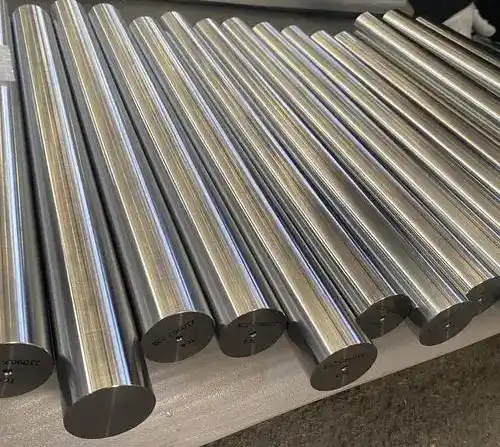
Understanding China GR4 Titanium Rods — Properties, Specifications, and Applications
In today's market for industrial materials, China GR4 titanium rod is the hardest commercially pure titanium grade available. This unalloyed titanium product has better mechanical performance because it has controlled interstitial strengthening, especially higher oxygen content (up to 0.40% maximum), which is what makes it fundamentally different from Grade 2 products that are softer.
Chemical Composition and Mechanical Strength
The chemical make-up of China Gr4 titanium rod closely follows ASTM B348 guidelines. It has an iron content of up to 0.50%, a carbon content of up to 0.08%, and a nitrogen content of up to 0.05%. This exact mix of elements gives it a minimum tensile strength of 550 MPa (80 ksi) and a yield strength of 483 MPa (70 ksi), which is almost twice as much as Grade 2 titanium's yield strength. The material keeps its 15% elongation, which is enough flexibility for cold forming processes while still keeping its structural integrity under repeated loads. The bars have a density of 4.51 g/cm³ and a melting point close to 1660°C. They are stronger than stainless steel and work better in uses that care about weight.
Corrosion Resistance and Thermal Stability
China Gr4 titanium rod is completely resistant to rust in seawater, stress cracking from chloride, and oxidizing acid conditions, such as those with nitric acid and wet chlorine. Because of this, the material is essential for underwater equipment, remote platform parts, and chemical reactor interiors where regular stainless steels break down too soon. From very cold temperatures (below 0°C) to about 425°C (800°F), the material keeps its shape and mechanical qualities. This means it can be used in most industrial hydraulic systems and heat exchangers.
Industrial Applications Across Critical Sectors
China Gr4 titanium rods made in China are used in many high-stakes businesses where failure of the material can have very bad results. In the aircraft industry, these rods are used to make hydraulic tubing fittings, firewall penetrations, and high-vibration fastener systems. Less weight directly affects fuel economy. China Gr4 titanium rod is used a lot in the oil and gas industry for wellhead equipment, underwater manifolds, and high-pressure valve stems that work in sour gas conditions with hydrogen sulfide. This material is used in chemical processing plants for pump shafts, anodizing racks, and heat exchanger support rods that deal with harsh media. Medical device makers use China GR4 titanium rod that meets ASTM F67 standards for dental implant posts and orthopedic bone screws.
Comparison and Quality Evaluation — China GR4 Titanium Rod vs Alternatives
When purchasing managers look at different China Gr4 titanium rod options, they have to make tough choices that balance mechanical performance, rust resistance, cost structures, and the stability of the supply chain. By knowing the technical trade-offs between China Gr4 titanium rod and other materials, you can choose the best material for almost any purpose.
Gr4 vs Gr2 Titanium Rod: Strength Without Compromising Corrosion Immunity
China Gr2 titanium rod, which is sometimes called "commercially pure titanium," is very resistant to rust and easy to shape. Its yield strength is about 275 MPa. Grade 2 works fine for low-stress uses like chemical holding tanks and building parts, but it doesn't work well for uses that need higher structural loads. China Gr4 titanium rod has a 75% higher yield strength while keeping the same levels of corrosion resistance. This makes it the obvious choice for use in hydraulic systems, pressure tanks, and situations with dynamic loads. Costs for China Gr4 titanium rod are usually 15–25% higher than those for Grade 2. This is a reasonable investment because China Gr4 titanium rod lasts longer and doesn't need as much cross-sectional area, which saves weight.
Gr4 vs Gr5 (Ti-6Al-4V) Titanium Alloy: Balancing Strength and Biocompatibility
Through alloying with aluminum and vanadium, Grade 5 titanium alloy can reach a maximum tensile strength of over 900 MPa. This makes it the workhorse of aircraft structural parts. But Grade 5's alloying elements could make medical devices less biocompatible and make them less resistant to corrosion in some reducing acid settings. China Gr4 titanium rod is a good compromise between pure titanium and aerospace alloys in terms of performance. It is strong enough for medical implants without posing any risks to cells and has better rust resistance in chloride-rich process streams. The cost of buying China Gr4 titanium rod is about 40–50% less than the cost of buying Grade 5, which makes it a great deal when the extra strength of Ti-6Al-4V is not needed.
Gr4 Titanium Rod vs Stainless Steel Alternatives
Grades of stainless steel like 316L are good at resisting corrosion in many chemical and sea settings, and they cost about one-third as much as China Gr4 titanium rod. But at 8.0 g/cm³, stainless steel's density is almost twice that of titanium. This means that mobile tools and offshore buildings have to carry a lot more weight. Stress corrosion cracking and crevice corrosion are also caused by salt in warm seawater situations where China Gr4 titanium rod works perfectly. Lead times for custom-diameter China Gr4 titanium rod from well-known Chinese companies like LINHUI TITANIUM are usually between 4 and 6 weeks for large orders. This is about the same as the time it takes to make specialty stainless steel forgings, but the titanium rod has better long-term performance, so it needs less maintenance and costs less overall.
Sourcing China GR4 Titanium Rods — A Procurement Manager's Guide
To successfully get China GR4 titanium rods from China, you have to deal with a complicated community of suppliers and handle quality control, price negotiations, and foreign shipping. Procurement workers with a lot of experience use strategic relationships with suppliers and thorough evaluation systems to get reliable supplies at prices that are competitive.
Identifying Qualified Manufacturers in China's Titanium Hub
China mostly makes titanium in Shaanxi Province, which has a lot of facilities that make titanium sponge and a lot of trained metalworkers. This gives the province a competitive edge. Xi'an is the hub of this industrial area. It is home to manufacturers ranging from small specialty companies to integrated titanium stores that sell a wide range of goods. LINHUI TITANIUM is a great example of an integrated supply model because they can heat, forge, roll, and very precisely machine China Gr4 titanium rods with diameters from 6mm to 300mm. When buying from potential suppliers, procurement teams should check their manufacturing licenses, third-party certifications from inspection agencies like SGS, TUV, and Bureau Veritas, and customer references from Fortune 500 companies or major EPC contractors that can show they have exported goods before.
Understanding MOQ Policies and Pricing Structures
Minimum order amounts for China Gr4 titanium rod are very different depending on the diameter, surface finish standards, and the level of customization needed. For standard diameter rods with centerless ground or peeled finishes, the minimum order quantity (MOQ) is usually 100 to 500 kilograms per dimension. For custom sizes or specialized surface treatments, the MOQ may need to be 1,000 kilograms to cover the cost of the tools. The price of China Gr4 titanium rod changes with the price of titanium sponge around the world. For normal industrial quantities, the price ranges between $35 and $55 per kilogram FOB Shanghai, and discounts are given for orders over 5,000 kilograms.
Navigating International Logistics and Compliance
Coordinating ocean freight, customs processing, and overland transfer are all parts of shipping China Gr4 titanium rod from China to North America. Reliable sellers, like LINHUI TITANIUM, work with specialized transportation companies that know how to handle metal goods. This makes sure that the goods are properly packed so that they don't get damaged during transit. As usual, rod bundles are packed in wooden boxes that have been padded on the inside and marked according to international standards. Customs classification under HS code 8108.90 makes it easier to figure out duties, which are different for each target country.
Why Choose China GR4 Titanium Rod Suppliers? Key Advantages for B2B Clients
Within the last twenty years, China's titanium manufacturing sector has changed a lot. It used to just make simple materials, but now it can make complex parts for the world's most demanding industry uses. For foreign buyers looking for China Gr4 titanium rod for important uses, this maturation process creates strong value arguments.
Advanced Manufacturing Capabilities and Quality Control
Leading Chinese companies have put a lot of money into high-precision tools and quality management methods that are on par with those used by Western companies. LINHUI TITANIUM uses vacuum arc remelting ovens to make sure that the China Gr4 titanium rod makeup is uniform, precision rolling mills to keep the dimensions within ±0.5mm, and automatic ultrasonic testing systems to find internal discontinuities bigger than 0.5mm in diameter. Every production lot goes through spectrographic analysis, tensile testing, hardness verification, and metallographic study in our quality control lab. Test results can be linked to specific heat numbers. The manufacturing processes follow ISO 9001:2015 guidelines, and they are regularly checked by registrars such as TUV Nord. Product certifications from classification societies DNV, ABS, and Lloyd's Register allow direct specification in marine and offshore projects without the need for extra qualification testing.
Cost Efficiency Without Quality Compromise
China's combined titanium supply chain, which includes making China Gr4 titanium rod sponges and finished rods, lowers prices by 20 to 35 percent compared to North America and Europe for the same level of quality. The lower cost of labor, economies of scale in the production of titanium sponge, and government funding for strategic materials businesses are what make these savings possible. Quality standards have not been lowered. When international buyers work with well-known makers, they can get these price benefits while still being able to track the goods and make sure they meet ASTM standards. LINHUI TITANIUM's pricing structure takes these competitive factors into account while maintaining high-quality standards.
Comprehensive Product Portfolio and Customization Flexibility
China's titanium industry is well-developed and can support a wide range of products beyond normal stock items. Like "titanium supermarkets," manufacturers like LINHUI TITANIUM sell China Gr4 titanium rod along with related goods like Grade 2, Grade 5, Grade 7, and Grade 12 rods, as well as titanium plate, pipe, wire, and fabricated parts. With this wide range of products, you can combine your buying, which cuts down on the costs of managing suppliers and lets you take advantage of volume contracts across many product categories. Customization options include non-standard sizes, unique surface finishes like electropolishing, custom length cuts, and services that add value, like precision machining or heat treatment. Engineering support teams help customers choose the right material, understand their specifications, and fix problems with their applications.
How to Identify and Verify Genuine China GR4 Titanium Rods
For foreign titanium buying to be quality assured, strict verification processes must be in place to protect against low-quality materials, wrongly identified grades, and fake licenses. Smart buyers use multi-layered identification methods to verify a China Gr4 titanium rod.
Documentation Requirements and Certification Verification
Shipments of real China Gr4 titanium rod must include full mill test papers that list the metal's chemical make-up, mechanical properties, history of heat treatment, and test method sources. These certificates should list relevant standards, like ASTM B348, and have stamps from an approved laboratory. Check the validity of the certification by comparing the heat numbers that are marked on the material with those that are listed on the mill certificates. This will prove that the unique identifier can be tracked. Ask for copies of the supplier's quality management system certifications, such as their ISO 9001 registration, and make sure that the registrar is legitimate and that the certifications are still valid. For projects that need approval from a classification society, make sure you get certificates from DNV, ABS, Lloyd's Register, or another appropriate authority that clearly list the provided heat numbers.
Physical Inspection Techniques and Material Testing
When looking at the sides of China Gr4 titanium rods, they should have a uniform metallic sheen with no large scales, deep scratches, or foreign matter buried in them. For example, a surface finish called "centerless ground" should have circular grinding marks that are usually less than 1.6 micrometers rough. Use accurate micrometers to check that the dimensions are correct and that the diameter errors are within the ranges that were given. Rod ends should have material markings that are stamped or laser-etched and show the heat number, grade name, and maker information. These markings should meet the standards of ASTM A1058 for tracking.
Conducting Effective Supplier Audits
On-site factory checks give a full picture of the factory's manufacturing skills, quality control methods, and overall organizational skills. Effective checks look at how raw China Gr4 titanium rod materials are bought and make sure that sellers get titanium sponge from qualified producers who keep the chemicals under control. Look over the upkeep records for production equipment, the calibration certificates for testing equipment, and the training records for quality staff. Check how the materials are handled to make sure they are properly identified and separated so that grades don't get mixed up by accident. Look at old records of customer complaints and corrected action to see how well you responded to quality problems. Customers can do audits of LINHUI TITANIUM at any time. The company has housed technical teams from large oil companies, EPC contractors, and marine classification societies. Our Xi'an plant uses complete quality management systems that include statistical process control, efforts to make the system better all the time, and customer feedback loops to make sure that performance stays up to global standards.
Conclusion
Buying China Gr4 titanium rod from Chinese makers has a lot of benefits, such as low prices, a wide range of products, and a history of good quality. However, buyers should only work with reputable sellers who can show they know how to make the rod and have international certifications. By learning about the properties of materials, carefully evaluating suppliers, and putting in place strong verification protocols, procurement teams can save money while still meeting the high-quality standards needed for demanding uses in the medical, chemical processing, aerospace, and marine industries. LINHUI TITANIUM has been providing world-class projects for 20 years, which shows that Chinese titanium manufacturers can meet global standards for performance and supply chain reliability, which supports long-term strategic relationships.
FAQ
How does Gr4 titanium rod differ from Grade 2?
Compared to Grade 2, China Gr4 titanium rod has more oxygen (up to 0.40%) and iron (up to 0.50%), which act as intermediate strengthening elements. This change in makeup gives it almost twice as much yield strength (483 MPa vs. 275 MPa for Grade 2) while keeping the same levels of corrosion protection. Both grades can be welded and are biocompatible, but China Gr4 titanium rod has better mechanical qualities that make it better for higher-stress uses like hydraulic systems and structural load-bearing parts, where Grade 2 would need bigger cross-sections.
Can Gr4 titanium rod be welded effectively?
When shielding is done correctly, normal TIG or MIG welding methods can be used to join China Gr4 titanium rod together very well. To weld properly, you need argon or helium shielding gas that is very pure to keep the weld pool and heat-affected areas clean from airborne particles. During cooling, oxidation can't happen because of trailing shields and backing gas. This keeps the mechanical features and corrosion protection of the weld joints. Before the weld, the surface is cleaned to get rid of any contaminants. After the weld, the joint is inspected visually, with dye penetrant tests, or with X-rays, based on how important the application is.
Is Gr4 titanium rod suitable for marine environments?
When it comes to corrosion resistance, China Gr4 titanium rod does better than stainless steels and copper-nickel metals in ocean and coastal environments. The material can withstand stress corrosion cracking caused by salt, crevice corrosion, and biofouling-accelerated attack that normally damage materials. China Gr4 titanium rod is very resistant to corrosion, which makes it perfect for use in underwater equipment, offshore platform parts, saltwater cooling systems, and marine propulsion parts that work in warm tropical seas or cold Arctic conditions without coatings or cathodic protection systems.
What surface finishes are available for Gr4 titanium rod?
Standard finishes for China Gr4 titanium rod's surface include centerless grinding, which gives it tight size tolerances and smooth surfaces with a roughness of 1.6 micrometers or better; peeled finish, which gets rid of surface scale by rotary peeling, leaving clean metal surfaces; and hot-rolled or forged conditions, which leave descaled surfaces ready for further machining. Specialized finishing, such as electropolishing, precise turning, and custom surface treatments, can be used for different kinds of jobs. When it comes to our full range of diameters, LINHUI TITANIUM can finish any metal to the exact specs of the customer.
Why choose Gr4 over Gr5 (Ti-6Al-4V) for certain applications?
Choose China Gr4 titanium rod when you need the weathering profile of commercially pure titanium or when you are worried about the aluminum and vanadium alloying elements. For medical implants, China Gr4 titanium rod is biocompatible and doesn't have any risks of sensitivity from alloy elements. In chemical processing settings with reducing acids, pure titanium is better because it doesn't rust as easily as Ti-6Al-4V. Cost is another factor that affects the choice of material. For example, when the extra strength of an aircraft metal is needed, China Gr4 titanium rod costs 40 to 50 percent less than Grade 5. China Gr4 titanium rod fills in the performance gap between lighter pure grades and high-strength alloys, making the balance between strength, cost, and resistance to rust perfect.
Partner with LINHUI TITANIUM for Your Gr4 Titanium Rod Requirements
If you need to buy China Gr4 titanium rods, LINHUI TITANIUM is ready to help. They have been making these rods for decades for global energy leaders, EPC companies, and industry OEMs. In our Xi'an factory, we make China Gr4 titanium rod that meets the requirements of ASTM B348. The diameters range from 6mm to 300mm, and the surfaces can be centerless ground, peeled, or polished. We have all the necessary foreign certifications, such as PED 2014/68/EU, ISO 9001:2015, and approvals from DNV, ABS, CCS, BV, and Lloyd's Register. This ensures that all project requirements are met without any problems. As a reliable China Gr4 titanium rod provider, we serve customers from more than 60 countries and offer reasonable prices, the ability to make changes, and expert technical support throughout the entire buying process. You can email our engineering team at linhui@lhtitanium.com to talk about your unique needs, get full quotes, or set up a plant visit to our Xi'an titanium products supermarket.
References
1. Boyer, R., Welsch, G., and Collings, E.W. (1994). Materials Properties Handbook: Titanium Alloys. ASM International, Materials Park, Ohio.
2. Donachie, Matthew J. (2000). Titanium: A Technical Guide, 2nd Edition. ASM International, Materials Park, Ohio.
3. ASTM International (2021). ASTM B348-13: Standard Specification for Titanium and Titanium Alloy Bars and Billets. West Conshohocken, Pennsylvania.
4. Schutz, R.W. and Thomas, D.E. (1987). "Corrosion of Titanium and Titanium Alloys." Metals Handbook, 9th Edition, Volume 13: Corrosion. ASM International, pp. 669-706.
5. Veiga, C., Davim, J.P. e Loureiro, A.J.R. (2012). "Properties and applications of titanium alloys: A brief review." Reviews on Advanced Materials Science, Volume 32, pp. 133-148.
6. Lutjering, G. and Williams, J.C. (2007). Titanium, 2nd Edition: Engineering Materials and Processes. Springer-Verlag, Berlin Heidelberg.