
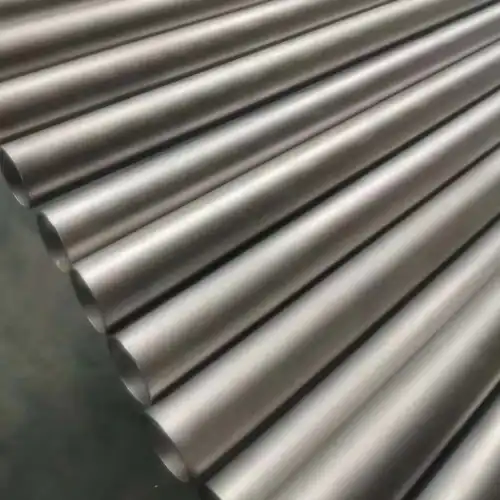
With the help of advanced precision engineering and specialized manufacturing methods, Custom Titanium Tubing can be made to exact specs. Modern titanium manufacturing technology lets companies make tubes with as little as 0.05 mm of error while still meeting strict chemical, mechanical, and size requirements. Because it can be made to exact measurements, custom titanium tubing is the best choice for important uses in the aerospace, medical, energy, and automobile industries where normal sizes won't do.
Understanding Custom Titanium Tubing and Its Properties
Custom Titanium Tubing is the peak of precision engineering. It uses advanced metallurgy and complex production methods to make tubes that are exactly what is needed for tough industrial uses. Custom solutions, on the other hand, are made to meet specific engineering needs when normal dimensions, alloy compositions, or mechanical qualities don't meet project needs.
Manufacturing Methods and Grade Selection
Choosing the right titanium grade and production process is the first step in making perfect custom tubes. To get the right size and finish on the outside, our factories use a variety of manufacturing methods, such as cold drawing, seamless extrusion, and rotating forging. Grade 2 titanium is very flexible and doesn't rust, which makes it perfect for heat exchanges in naval settings. For aircraft hydraulic systems, Grade 9 (Ti-3Al-2.5V) has the best strength-to-weight ratio, and Grade 5 (Ti-6Al-4V) has the highest structural strength for high-stress situations. Each grade has its own unique properties that affect how well it works in manufacturing and in use. The cold working and stress release methods can be changed to make the metal easier to shape while still preserving the benefits of titanium's passive oxide layer, which makes it very resistant to corrosion in a wide range of chemical environments.
Material Properties Driving Industrial Adoption
Titanium is essential for uses that need both speed and dependability because it has a unique set of qualities. The mass of titanium tubing is about 4.51 g/cm³, which makes it 45% lighter than a steel tube of the same size while still being stronger. The biocompatibility of the material makes it safe for use in medical implants and surgical equipment. Its thermal stability also lets it be used at temperatures up to 315°F (600°C) without losing much of its power. Titanium is very resistant to rust because it can form a protective oxide film when it comes in contact with oxygen. This film acts as a shield that stays stable in harsh environments like seawater, acids, and industrial chemicals. Compared to other materials, this trait makes the product last a lot longer and requires less upkeep.
How Custom Titanium Tubing Can Be Made to Exact Specifications
To get accurate results when making titanium tubes, you need complex process control and quality management methods. Modern manufacturing can meet even the toughest specifications while keeping quality high across big production runs, as our production skills show.
Advanced Manufacturing Processes
From raw titanium to precision tubes, it goes through a number of specialized steps, each of which improves the accuracy and performance of the end product. When you use seamless extrusion, the walls are all the same thickness, and there are no weld gaps that could lower the pressure values or shorten the fatigue life. With cold drawing, the outer diameter, inner diameter, and wall thickness can all be made to very close standards, and the quality of the surface finish is also improved. CNC machines can make complicated shapes, like tapered curves, walls that are different widths along the length of the tube, and ends that need special preparations. Laser welding technology makes sure that the seam quality is always the same in welded structures. It also keeps the corrosion-resistant properties of the base material by controlling the amount of heat used and treating it after the weld.
Quality Control and Certification Standards
Strict quality control checks make sure that every tube meets the standards before it is shipped. Laser micrometers and coordinate measuring tools are used for dimensional checking to check tolerances. Ultrasonic testing, on the other hand, finds internal breaks that could affect performance. Eddy current testing finds surface and near-surface flaws, which makes sure the structure stays strong when it's under working loads. For material certification, X-ray fluorescence research is used to positively identify the material and make sure that its chemical makeup meets ASTM, AMS, and EN standards. Tensile strength, yield strength, and stretch traits are checked by mechanical testing. Specialized tests, such as flattening and flaring, check the material's ability to be shaped. There are mill test certificates, inspection reports, and tracking records in documentation packages that help meet customer quality standards and government regulations.
Comparing Custom Titanium Tubing with Alternative Materials
When procurement workers know how Custom Titanium Tubing performs better than other materials, they can make smart choices based on the total cost of ownership instead of just the initial cost of materials. The comparison shows that titanium has important long-term benefits that support its high price.
Performance Advantages Over Stainless Steel and Aluminum
Titanium is stronger than both stainless steel and aluminum when it comes to weight, so it can be used to make lighter systems that don't lose their strength. Even though 316L stainless steel is good at resisting corrosion, titanium is better for naval and chemical processing uses because it doesn't crack when exposed to chloride stress corrosion. The lower thermal conductivity of the material compared to aluminum keeps heat from escaping in thermal management systems, and its higher melting point lets it work at high temperatures. Another important benefit is that it doesn't wear down easily, which is especially useful in aircraft situations where vibration and pressure changes happen all the time. Titanium's fatigue limit is close to 60% of its ultimate tensile strength, while many steel alloys' limits are only 40%. This feature makes parts last longer and requires less upkeep, which makes up for higher starting costs by making things more reliable.
Grade-Specific Applications and Trade-offs
Depending on the needs of the product, different types of titanium offer different benefits. Commercial pure types (1-4) offer the best resistance to rust and ductility, making them perfect for use in chemical handling equipment and buildings. Alpha-beta metals, such as Grade 5, are stronger, but they need more complex shaping methods and may not be as resistant to rust in some places. For many commercial uses, Grade 9 is the best combination of strength, formability, and resistance to rust. The addition of 3% aluminum and 2.5% vanadium makes it much stronger while keeping its good cold-forming properties. This grade is now the standard for hydraulic tubing in commercial airplanes and high-performance sports equipment, where lowering weight has a direct effect on performance.
Procurement Considerations for Custom Titanium Tubing
A successful buy of precision Custom titanium tube requires you to carefully evaluate suppliers and be clear about what you need. Knowing the important things that go into buying things can help make sure that a project succeeds while lowering the risks that come with material quality and delivery times.
Supplier Evaluation Criteria
Suppliers you can trust have complete quality control systems that are backed by certifications like ISO 9001:2015, AS9100 for aerospace uses, and ISO 13485 for medical products. In-house testing facilities, advanced process controls, and written methods for meeting customer requirements should all be part of a manufacturer's skills. Audits of suppliers make sure that their real skills match the certifications they say they have and look for possible quality or delivery problems. Costs and delivery times are both affected by where the goods are shipped. Local suppliers may be easier to work with and communicate with, while global sellers may offer better prices or more specialized services. When judging a provider, you should look at how well they've done with similar projects in the past, how well they can help with technical issues, and how well they can increase production to meet future needs.
Order Logistics and Documentation Requirements
Lead times for special tubes are usually between 4 and 12 weeks, but they depend on how complicated the specifications are and how much you order. When it comes to special alloys or big-diameter tubes that need special mill processing, the supply of raw materials can affect plans. Due to setup costs and the need to buy materials, minimum order numbers are often required. However, experienced suppliers can sometimes work with smaller amounts by organizing campaigns. Different industries and applications have different documentation needs. For example, aircraft and nuclear uses need a lot of documentation for material traceability and approval. Standard outputs include mill test certificates, measurement inspection records, and material safety data sheets. For more specific uses, extra tests like intergranular corrosion testing or fatigue analysis may be needed.
Why Trust LINHUI TITANIUM's Custom Titanium Tubing Solutions
LINHUI TITANIUM has been making titanium products for 21 years and can provide precision-engineered solutions that meet the strictest requirements in the aircraft, medical, energy, and automobile industries. Our wide range of industrial skills and long history of success show that we are dedicated to producing high-quality custom tubes.
Manufacturing Excellence and Global Standards
There are 30 dedicated production lines in our two specialized plants. These lines can do advanced cold drawing, rotary casting, and laser welding. Because of this infrastructure, we can make Custom Titanium Tubing from Grade 1 to Grade 23 materials while strictly following international standards like ASTM, ASME, ISO, AMS, and MIL. Our methods are safe for important uses because they have quality approvals from DNV, ABS, CCS, GL, and other classification societies. We can meet complicated requirements that other providers can't because we have a wide range of manufacturing skills. Our methods meet the needs for precise measurements and high-quality surfaces, whether they are making ultra-thin wall tubing for medical devices or big diameter pipes for chemical processing. Advanced material controls make sure that the mechanical properties stay the same from one production run to the next. This gives safety-critical uses the dependability they need.
Proven Performance with Industry Leaders
Big foreign companies like PETRONAS, PEMEX, and other Fortune 500 companies are among our customers. They depend on our goods for mission-critical tasks. These partnerships show that we can meet strict quality standards and offer expert help throughout the entire project lifecycle. Our success with energy companies' hydrogen storage tanks shows that we know how to use new technologies well, and our aircraft parts meet the strict requirements of commercial flying. Case studies from medical device uses show how precise we can be, since the success of a product depends on limits measured in micrometers. Our seamless hydraulic tubing has been used in millions of hours of business flights, which proves the quality of the material and the stability of the production process. Applications in the automotive industry, such as EV battery cooling systems, show that we can change established methods to meet the needs of new markets.
Conclusion
Custom Titanium Tubing made to exact specs is a must-have for businesses that need the highest levels of accuracy, performance, and dependability. Advanced manufacturing methods, strict quality control, and specialized knowledge are what make it possible to make tubing options that meet the toughest performance and size requirements. Because we have been in business for 21 years, have many certifications, and have built strong relationships with top companies in our field, LINHUI TITANIUM is the best choice for companies that need precision titanium tubing solutions that work well in tough situations.
FAQ
What dimensional tolerances can be achieved with custom titanium tubing?
With today's high-tech assembly, measures of the outer diameter, inner diameter, and wall thickness can be accurate to within 0.05 mm. Even tighter tolerances can be reached with specialized techniques for small-diameter tubing used in aircraft and medical fields. Length limits are usually between ±1mm and ±5mm, but they can be bigger or smaller based on the length of the tube and the way it was cut.
Which certifications should procurement teams request for material compliance?
Essential certifications include ASTM material compliance certificates, mill test certificates showing chemical analysis and mechanical properties, and dimensional inspection reports. Aerospace applications require AMS compliance, while medical applications need ASTM F67 or F136 certification. Third-party inspection by agencies like DNV, SGS, or TUV provides additional verification for critical applications.
How do lead times differ between custom and standard tubing orders?
Standard titanium tubing from inventory typically ships within 1-2 weeks, while custom orders require 4-12 weeks, depending on specification complexity. Specialized alloys or non-standard dimensions may extend lead times due to raw material procurement requirements. Complex geometries requiring custom tooling can add 2-4 weeks to standard lead times for initial orders.
Can titanium tubing be produced with varying wall thickness along its length?
Yes, specialized manufacturing processes can create butted tubing with varying wall thickness to optimize strength-to-weight ratios. This technique is commonly used in aerospace applications and high-performance sporting goods where material placement directly impacts performance. CNC machining can also create tapered profiles and complex internal geometries.
What surface finishes are available for custom titanium tubing applications?
Available finishes include acid-etched surfaces for subsequent anodizing, polished finishes for aesthetic applications, and centerless ground surfaces for precision diameter control. Internal surfaces can be honed for improved fluid flow characteristics, while specialized coatings can be applied for enhanced wear resistance or specific performance requirements.
Partner with LINHUI TITANIUM for Your Custom Titanium Tubing Requirements
LINHUI TITANIUM combines two decades of manufacturing excellence with cutting-edge technology to deliver Custom Titanium Tubing solutions that exceed industry standards. Our comprehensive capabilities span Grade 1-23 alloys, advanced processing techniques, and rigorous quality systems that ensure every product meets your exact specifications. As a trusted custom titanium tubing supplier, we provide the technical expertise, manufacturing flexibility, and global logistics capabilities essential for successful project execution. Contact our engineering team at linhui@lhtitanium.com to discuss your specific requirements and discover how our proven solutions can enhance your next project's performance and reliability.
References
1. Boyer, R.R. "An Overview on the Use of Titanium in the Aerospace Industry." Materials Science and Engineering A, Vol. 213, No. 1-2, 1996.
2. Donachie, Matthew J. "Titanium: A Technical Guide, Second Edition." ASM International Materials Park, Ohio, 2000.
3. American Society for Testing and Materials. "ASTM B338-18: Standard Specification for Seamless and Welded Titanium and Titanium Alloy Tubes for Condensers and Heat Exchangers." ASTM International, 2018.
4. Peters, M. and Leyens, C. "Titanium and Titanium Alloys: Fundamentals and Applications." Wiley-VCH Verlag GmbH & Co., Weinheim, Germany, 2003.
5. SAE International. "AMS 4943G: Titanium Alloy Tubing 3Al-2.5V Seamless Hydraulic." SAE Aerospace Material Specification, 2019.
6. Lutjering, G. and Williams, J.C. "Titanium: Engineering Materials and Processes." Springer-Verlag Berlin Heidelberg, Second Edition, 2007.