
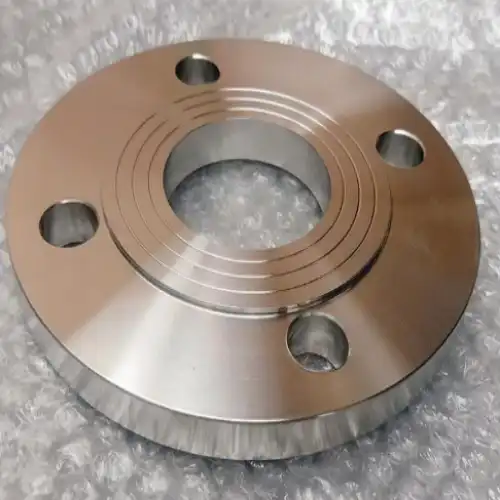
ASTM B381 Gr2 Titanium Flange
Standard: ASTM B381 / ASME B16.5
Grade: Gr2 Titanium (UNS R50400)
Advantage: Superior seawater & chloride resistance
Range: ½"–60" · Class 150#–2500#
Certification: EN 10204 3.1 MTC






ASTM B381 Gr2 titanium flange is a forged pipe flange manufactured from Grade 2 commercially pure titanium (UNS R50400) under the ASTM B381 specification for annealed titanium forgings. It delivers excellent corrosion resistance in seawater, chlorides, and oxidizing acids, making it the material of choice for chemical processing, desalination, marine piping, and heat exchanger connections where stainless steel or carbon steel would fail prematurely.
As a direct titanium flange manufacturer, we produce and export forged Gr2 flanges in weld neck, slip-on, blind, socket weld, threaded, and lap joint configurations. Dimensional requirements follow ASME B16.5 (½"–24") or ASME B16.47 (larger sizes), with pressure classes from 150# to 2500#. Whether you need standard ASME flanges or custom-machined components per drawing, we help you specify the right grade, face type, and certification for your project.
Send your specifications — receive a quotation and MTC sample within 24 hours.
Key Features & Advantages
- Superior Chloride Corrosion Resistance: Grade 2 titanium is virtually immune to general corrosion in seawater and wet chlorine, with safe continuous service up to approximately 80°C before crevice corrosion risk increases.
- Forged for Pressure Integrity: ASTM B381 requires forged material, ensuring dense grain structure and reliable performance under multiaxial stress compared to plate-cut or cast alternatives.
- Complete Dimensional Compliance: Manufactured to ASME B16.5 or ASME B16.47 with pressure classes 150#–2500#, available in RF, FF, and RTJ face configurations.
- Full Material Traceability: EN 10204 3.1 mill test certificates with heat number marking provided as standard, supporting your project’s quality documentation requirements.
- Custom Machining Capability: Non-standard sizes, special bores, and custom bolt patterns available per drawing (PDF/DWG).
- Lightweight & Maintenance-Free: Approximately 45% lighter than steel, reducing structural load and installation effort while eliminating the need for protective coatings.
Product Specifications
| Parameter | Specification |
|---|---|
| Material Standard | ASTM B381 (Titanium and Titanium Alloy Forgings) |
| Grade | Grade 2 / Grade F-2 / UNS R50400 (Commercially Pure Titanium) |
| Dimensional Standard | ASME B16.5 (½"–24") · ASME B16.47 (26"–60") · EN 1092-1 · DIN · JIS (custom) |
| Flange Types | Weld Neck (WNRF), Slip-On (SORF), Blind (BLRF), Socket Weld (SWRF), Threaded, Lap Joint, RTJ |
| Pressure Class | 150#, 300#, 600#, 900#, 1500#, 2500# (PN 6–PN 260 available) |
| Face Type | Raised Face (RF), Flat Face (FF), Ring Type Joint (RTJ) |
| Size Range | ½" to 60" (DN15–DN1500) |
| Mechanical Properties | Tensile ≥ 345 MPa · Yield ≥ 275 MPa · Elongation ≥ 20% |
| Density | 4.51 g/cm³ |
| Surface Treatment | Machined finish; pickled or passivated upon request |
| Packaging | Individual wrapping with face protection; wooden cases or pallets |
| Customization | Custom drawings, special bores, third-party inspection (SGS/TÜV/BV) |
Manufacturing Process
Our Gr2 titanium flanges are manufactured through six controlled steps to ensure forging integrity and dimensional accuracy:
1. Raw Material Selection
We use high-purity titanium sponge and master alloys, verified for chemistry before melting to eliminate high-density inclusions (HDI) and ensure Grade 2 compliance.
2. Melting & Ingot Casting
Titanium sponge is pressed into electrodes and vacuum arc remelted (VAR) to produce homogeneous ingots with controlled interstitial content.
3. Forging
Ingots are heated and forged above the beta transus, then finished in the alpha-beta phase to refine grain structure. This controlled forging sequence develops the mechanical properties required for pressure-retaining flanges.
4. Heat Treatment
Forged blanks are annealed to relieve internal stress and achieve the specified tensile and yield properties per ASTM B381.
5. Precision Machining
Flanges are turned, drilled, and faced to the ordered dimensional standard (ASME B16.5/B16.47). Gasket contact surfaces are machined to the specified finish (RF, FF, or RTJ groove).
6. Inspection & Packaging
Each flange undergoes dimensional verification, visual inspection, and PMI (positive material identification) testing. Sealing faces are protected with plastic caps or wrapping before wooden case packing.
Quality Assurance & Testing
We operate a lot-by-lot release system—no flange ships without passing our full QC protocol.
Chemical composition by optical emission spectrometry (OES) or ICP
Mechanical properties (tensile, yield, elongation) per ASTM B381
Dimensional inspection per ASME B16.5/B16.47 or customer drawing
Surface and sealing face inspection (RF/FF/RTJ profile)
PMI testing to verify Grade 2 chemistry on finished parts
Hydrostatic testing available per ASME B16.5 Appendix A upon request
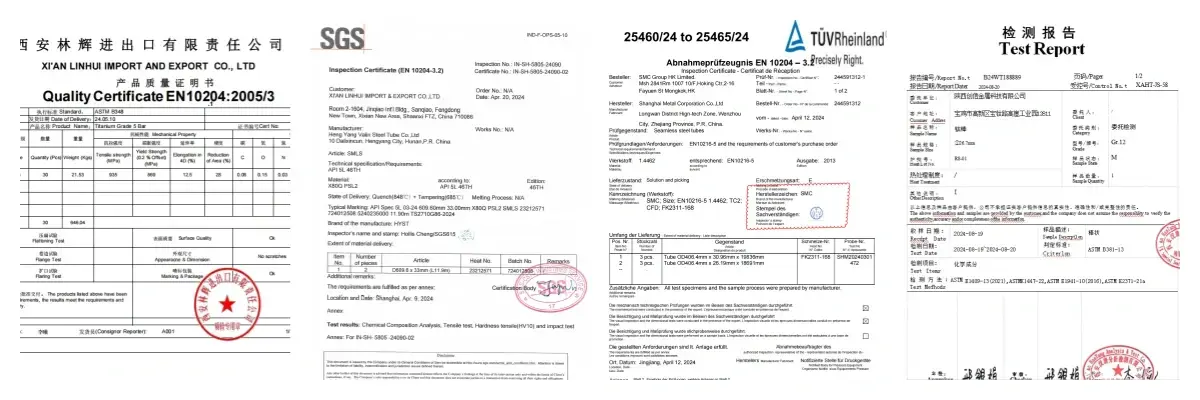
Documentation provided: EN 10204 3.1 Mill Test Certificate (MTC) with heat number traceability, dimensional inspection report, and packing list. Third-party inspection (SGS, TÜV, Bureau Veritas) can be arranged at buyer’s request.
Applications
- Chemical Processing
Grade 2 flanges are specified for piping handling wet chlorine, hypochlorites, nitric acid, and other oxidizing media where stainless steel suffers pitting or stress corrosion cracking.
- Seawater & Desalination Systems
Titanium’s immunity to chloride attack makes Gr2 flanges ideal for seawater cooling lines, RO desalination trains, and marine piping systems.
- Heat Exchangers & Process Equipment
Flanged connections on titanium heat exchangers, reactors, and pressure vessels benefit from Gr2’s corrosion resistance and moderate strength.
- Chlor-Alkali & Pulp/Paper
Wet chlorine service requires titanium; Grade 2 flanges are standard for this critical application (Note: titanium must never be used in dry chlorine gas).
Why Choose Us?
Forging Quality You Can Audit
We supply ASTM B381 forged flanges, not plate-cut substitutes. Each heat number is traceable from ingot to finished part, with mechanical test reports confirming compliance to the ordered grade and condition.
Dual-Standard Competence
We understand that a flange order requires two specifications: the material standard (ASTM B381) and the dimensional standard (ASME B16.5/B16.47). Our quotation confirms both, preventing the ambiguity that causes rejected shipments.
Application-Specific Guidance
Tell us your service medium, temperature, and pressure class. We’ll recommend the appropriate face type, gasket compatibility, and whether Grade 2 is suitable or if a higher grade (Gr7, Gr12) is warranted for your corrosion environment.
Export-Ready Packaging & Documentation
Flange sealing faces are protected against transit damage. MTC, packing list, and export compliance documents are prepared to your project’s requirements.
FAQ
Q1: What is the difference between ASTM B381 and ASME B16.5 for flanges?
ASTM B381 is the material specification for titanium forgings—it defines chemistry, mechanical properties, and heat treatment. ASME B16.5 is the dimensional specification—it defines flange dimensions, pressure ratings, and tolerances. A complete flange order must reference both: material per B381 and dimensions per B16.5 (or your project drawing).
Q2: Is Grade 2 suitable for seawater service?
Yes. Grade 2 titanium is virtually immune to general corrosion in seawater. However, crevice corrosion can occur under gaskets at temperatures above approximately 80°C. For higher-temperature seawater service, Grade 7 (Ti-0.2Pd) or Grade 12 may be recommended.
Q3: What flange types do you supply in Gr2?
We supply Weld Neck (WNRF), Slip-On (SORF), Blind (BLRF), Socket Weld (SWRF), Threaded, Lap Joint, and RTJ configurations. Weld Neck is preferred for high-pressure and cyclic service; Slip-On is suitable for lower-pressure applications; Blind is used for sealing line ends or future expansion.
Q4: Can you provide EN 10204 3.1 or 3.2 certification?
Yes. EN 10204 3.1 MTC with heat number is standard. 3.2 certification (third-party witnessed testing) can be arranged upon request.
Q5: What information do I need to provide for a quotation?
Please provide: flange type (WNRF/SORF/BLRF/etc.), nominal pipe size, pressure class (150#/300#/etc.), face type (RF/FF/RTJ), dimensional standard (ASME B16.5 or drawing), quantity, and any certification or third-party inspection requirements.
Q6: What is your MOQ and lead time?
MOQ is 10 pieces for standard sizes. Lead time is 2–3 weeks for stock sizes; 4–6 weeks for custom dimensions or RTJ facing. Complex custom machining may require additional time—confirmed at quotation.
Contact Us
Looking for a reliable ASTM B381 Gr2 titanium flange supplier?
Whether you need standard ASME B16.5 titanium slip-on flanges, custom forged Grade 2 titanium weld neck flanges for seawater systems, or RTJ-faced flanges for high-pressure chemical piping, our engineering team is ready to help you finalize the exact specification.
To receive a precise quotation and MTC sample within 24 hours, please provide:
Product Details: Flange type (WNRF, SORF, BLRF, SWRF, etc.), size (NPS/DN), and pressure class (e.g., 150#, 300#).
Material & Standards: ASTM B381 Grade 2 (UNS R50400) with dimensional standard (ASME B16.5 or custom drawing).
Technical Requirements: Face type (RF/FF/RTJ), surface finish, or specific testing requirements.
Order Info: Estimated annual quantity and required certification (e.g., EN 10204 3.1 MTC).
Get in Touch Today! Email: linhui@lhtitanium.com