- English
- Search
- English

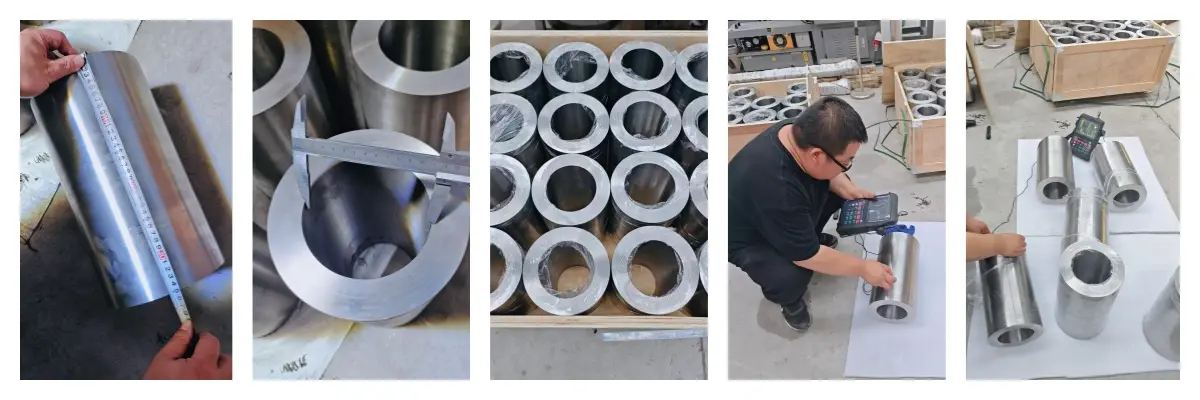
A recent order for titanium tubes from a Turkish client has been successfully dispatched. The specification: AMS 4935 Ti-6Al-4V, with an outer diameter of 200 mm, inner diameter of 130 mm, and length of 350 mm. Shipped from Shanghai Port under FOB terms via LCL sea freight, this marks the ninth time this Turkish client has placed an order for the same product.
Client Background: A Reflection of Turkey's Growing High-End Manufacturing Sector
Turkey's titanium alloy market is on a steady upward trajectory. Driven by the aerospace, defense, and medical manufacturing industries, demand for high-grade titanium materials continues to rise. The aerospace and marine engineering sectors, in particular, represent the largest areas of application.
This client is a prime example of that trend. As a specialized manufacturer based in Turkey, the company is involved in the production of aerospace structural components and high-end industrial equipment. Nine repeat orders are not just a number — they signal sustained, rigid demand for titanium alloys and reflect Turkey's clear shift toward higher value-added manufacturing.
Order Details: Specifications Tailored for High-End Industrial Use
| Item | Details |
|---|---|
| Product | Titanium Tube |
| Material Specification | AMS 4935 Ti-6Al-4V |
| OD × ID × Length | 200mm × 130mm × 350mm |
| Mode of Transport | LCL, by sea, from Shanghai Port |
| Incoterms | FOB Shanghai Port |
| Delivery Timeline | 30 days after payment receipt |
| Destination | Turkey |
Ti-6Al-4V (Grade 5) is the most widely used α+β titanium alloy. Under the AMS 4935 aerospace material specification, it offers a minimum tensile strength of 895 MPa, minimum yield strength of 828 MPa, and elongation of at least 10%. The client's continued choice of this grade suggests the tubes are destined for applications where strength and reliability are non-negotiable.
Solutions: From Order Placement to Delivery — A Complete Chain
For a Turkish client to choose the same supplier nine times is no coincidence.
Material Certification. AMS 4935 is an aerospace-grade specification with stringent requirements for chemical composition, mechanical properties, and full traceability. The typical chemistry of Ti-6Al-4V includes 5.5%–6.75% Al, 3.5%–4.5% V, Fe ≤ 0.30%, and O ≤ 0.20%. Meeting this specification demands mature metallurgical processes and a robust quality management system — both of which this supplier has consistently demonstrated.
Logistics Execution. This batch was shipped via LCL from Shanghai Port. LCL operations place higher demands on packaging, marking, and documentation, especially for high-value titanium materials that must be protected from impact and moisture during transit. The 30-day delivery window allows for a balanced production and shipping schedule, a rhythm that has been refined over multiple previous collaborations.
Why does this client keep coming back?
Long-term repeat business is never about price alone — it is about trust in overall execution capability. For the Turkish client, each order is a comprehensive test of quality, on-time delivery, and communication efficiency. Nine orders in, the supplier has passed every test:
Chemical composition and mechanical properties consistently meet AMS standards
Delivery schedules are predictable and reliable, never disrupting the client's own production planning
Logistics expertise, particularly in LCL sea freight, is proven and dependable
Cross-cultural communication and after-sales responsiveness are timely and effective
Inspection Methods: An Extra Layer of Quality Assurance
For aerospace-grade titanium tubes, rigorous inspection is essential. A standard testing protocol typically covers the following areas:
Chemical Composition Analysis. X-ray fluorescence spectrometry (XRF) or optical emission spectrometry (OES) is used to verify the alloy composition, ensuring that major elements such as Al and V, as well as impurities like Fe and O, fall within AMS 4935 limits. This step confirms the material's identity and integrity.
Dimensional Inspection. Outer diameter, wall thickness, and ovality must fall within specified tolerances. Industry practice generally requires OD tolerances to stay within ±1%, with ovality not exceeding 1% of the nominal OD.
Non-Destructive Testing (NDT). This is the critical step for detecting internal defects. Ultrasonic testing (UT) is applied to measure wall thickness and identify internal delaminations or inclusions, while eddy current testing (ET) is used to detect surface and near-surface cracks or flaws. Together, these methods ensure that both internal and external quality meet delivery requirements.
Surface Quality Inspection. Visual inspection and measurement tools are used to check inner and outer surfaces for cracks, scratches, dents, or discoloration caused by overheating during processing.
Upon completion of these inspections, the supplier issues a Mill Test Certificate (MTC) containing precise chemical composition data, mechanical property test results, and NDT findings, ensuring full traceability from raw material to finished product.







Stay Updated with linhui titanium
Get the latest tips and trends in the titanium industry.



Tel: +86-29-89506568
WA/Mob: +86-17778976690
Email: linhui@lhtitanium.com
Add: A: Room 3107, Runfeng Bldg, Sanqiao, Fengdong New Town, Xi'an City, Shaanxi Province, China.