
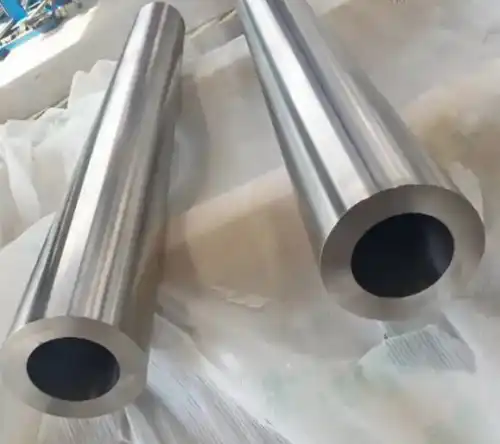
A titanium tube with thick walls is the best choice for businesses that work in tough situations when the job calls for it. These parts were carefully designed and manufactured to be stronger, less likely to rust, a thick-walled titanium tube, and more stable than parts made of other materials. Thick-walled titanium tubes are reliable enough to keep important tasks running smoothly and safely, whether they are on oil platforms that have to deal with rust from saltwater or in airplanes that have to handle high and low temperatures.
Understanding Thick-Walled Titanium Tubes and Their Properties
In mechanical engineering, the best tubes are those made of titanium with thick walls. There are times when regular pipes just aren't strong enough to do the job. These parts stand out because their walls are thick and strong. These days, it can be anywhere from 2 mm to 50 mm, depending on the job. The bigger walls can hold up against pressure and keep the building stable better than the thinner walls.
Advanced Material Composition
Titanium metals, mostly Grades 1–12, are carefully picked to make tubes with thicker walls. For different tasks, each grade is better than the last. To make chemicals, grade 2 titanium is great because it doesn't rust and is simple to shape. Grade 5 (Ti-6Al-4V) is very strong for how light it is, which makes it perfect for use in airplanes where weight reduction is important without losing strength.
Manufacturing Excellence
Vacuum arc remelting (VAR) technology is used by LINHUI TITANIUM to make flawless titanium billets. This makes sure that the wall of the tube is made of the same material all the way through. The sizes are accurate to within ±0.1mm thanks to our exact cold rolling and pilgering methods. Solution annealing makes the material qualities better and lowers the stress. This method for making tubes makes sure that each one meets the strict requirements needed for use in harsh conditions.
Superior Mechanical Properties
When it comes to how they work, thick-walled titanium tubes are better than other materials in a number of important ways. Pulling power ranges from 240 MPa for Grade 1 to over 900 MPa for Grade 5. That being said, it is still very loose. It saves weight compared to steel because it has a low density (4.5 g/cm³), and the fact that it is not magnetic makes it perfect for use in sensitive devices.
Comparing Thick-Walled Titanium Tubes with Alternative Materials
If you live in a tough environment, you need to carefully consider how well a material works, how much it costs over its lifetime, a thick-walled titanium tube, and how it needs to be maintained. If people who buy things know how thick-walled titanium tubes compare to other materials, they can make choices that are better for both performance and value.
Performance Advantages Over Traditional Materials
In salt environments, titanium tubes with thick walls are better at keeping their shape than stainless steel tubes. They don't have to worry about stress rust cracks like steel parts do. Even though stainless steel might be cheaper at first, titanium tools generally cost less in the long run because they last longer and don't need as much maintenance. Aluminum choices are less heavy than titanium ones, but they aren't as strong or able to handle high temperatures. Up to 500°C, titanium tubes with thick walls can still hold together, which is a lot higher than what aluminum can do. Because galvanic corrosion can damage aluminum quickly in naval settings, titanium is the more reliable choice in the long run.
Structural Robustness Benefits
The walls of these titanium tubes are stronger, so they can handle changes in pressure and wear very well. In hydraulic systems, where this trait is very useful, changes in pressure can make parts with weaker walls break before they should. The strong design lets more people work on it without compromising safety because it is made to last.
Selecting the Right Thick-Walled Titanium Tube for Your Needs
If you want to buy thick-walled titanium tubes, you need to think carefully about the technical needs, the skills of the seller, and the quality control measures. You can pick the best supplies for the job without spending too much if you know these things.
Critical Supplier Evaluation Criteria
You can judge a seller by the quality marks they offer. It has a lot of certificates, like ISO 9001:2015, TUV Nord AD2000-W0, and PED 2014/68/EU approval. It is okay for our companies to work with big classification societies like DNV, ABS, CCS, and BV. This makes sure that the things we make can be used in important ways that are governed by other countries. We've been making things for 21 years and can make up to 800 tons of stuff every year. This gives us the stability and ability to grow that big projects need. We have two dedicated buildings and 30 specialized production lines, so we can keep up with demand, meet special needs, and get things to you quickly.
Technical Specification Considerations
Precision in dimensions is still very important when they are used in tough conditions. We can keep wall thickness tolerances to within ±5% and width tolerances to within ±0.1mm because of how precisely we make our products. To use the surface in industry, it can be boiled or pickled. To use it in medicine or to keep it clean, the thick-walled titanium tube can be cleaned. Traceability of materials makes sure that all the information is in order, from where the raw materials come from to the review at the end. Each tube has information about heat on it and comes with paperwork that proves it is safe to use. This makes sure that the quality is good enough for important tasks and following the rules.
Optimizing Performance of Thick-Walled Titanium Tubes in Harsh Environments
You can get the most out of thick-walled titanium tubes by being careful about how they are put in place, how they are kept, and how their performance is monitored. Following these instructions properly will make sure that the equipment lasts longer and works reliably throughout its working life.
Installation Best Practices
It makes a big difference in how well thick-walled titanium tubes work in the long run how they are installed. Well-known rules, like AMS-T-9046 for aircraft uses or API 5L for oil and gas setups, tell you how to weld correctly. When experienced welders use the right filler materials and heat treatment after welding, they make sure that the strength of the joint matches the qualities of the base material. Failures don't happen too soon when you don't stress out during installation. As long as the support room, temperature expansion limit, and vibration isolation are all right, the structure of the tube will stay strong under real-world stress. These steps are very important in systems that are under a lot of stress, as stress can build up and lead to wear cracks.
Maintenance and Monitoring Strategies
Titanium tubes will work at their best for as long as they are used if they have preventative repair plans made just for them. Through regular visual checks, damage to the surface or the start of rust can be found. Non-destructive testing methods, such as ultrasound thickness measurement, can keep an eye on the wall's stability over time. Tools that check for corrosion let you know right away when changes in the environment might affect how well a tube works. If you keep an eye on pH levels, salt ratios, and temps, you can find places where rust might happen faster and stop it before it starts.
Real-World Performance Examples
Titanium tubes with thick walls work great in rough sea environments, as shown by the fact that oil rigs are mounted at sea. Saltwater, hydrogen sulfide, and changing pressures all quickly break down standard materials when tubes are used in these ways. Since they were first used more than 20 years ago, these titanium tubes haven't shown any major signs of wear. Titanium can handle strong acids because it is used in chemical processing. Titanium tubes with thick walls are used in heat exchangers and pipes in reactors that work with strong acids and chemicals that are chlorinated. Things could go horribly wrong if these tubes break.
Future Trends and Innovations in Thick-Walled Titanium Tube Technology
Materials science keeps making thick-walled titanium tubes better. There are also better ways to make them and more uses for them. These new changes should make them work better and let them be used in more places.
Advanced Manufacturing Technologies
Additive manufacturing is beginning to change the way thick-walled tubes are made, especially for special uses that need small amounts or forms that are hard to make. With 3D printing, you can change the wall thickness and shape of the internal channels in ways that aren't possible with other ways of making things. This lets you build things in more ways for different purposes. With tools for precise manufacturing, tubes can be made with walls of different widths all the way along their length. This is the best way to use the spread of information for different kinds of stress. This method keeps strength where it's needed while cutting down on weight. This is very helpful for use in airplanes, where every gram is important.
Emerging Application Sectors
Titanium tubes with thicker walls are being used more and more in geothermal systems and offshore wind farms to make clean energy. Titanium works well for these tasks since it doesn't rust and can last for a long time in harsh conditions. Green goals are met by the fact that the material can be recovered, a thick-walled titanium tube, which also gives long-term energy infrastructure the stability it needs. As new ways of making tubes with smaller sizes and more accurate wall thickness control come out, their uses in biomedical engineering keep growing. When reliability and biocompatibility are very important, these parts are used in medical devices and inside the body.
Sustainability Initiatives
Because people care about the environment, new ways of making titanium tubes are being developed. Energy-efficient ways of making things keep quality standards high and reduce the amount of carbon dioxide that is released when tubes are made. Better ways to recycle titanium mean that it can be taken from old parts and used again, which is in line with the cycle economy ideas. Modern surface treatments make things less likely to rust without changing how they work. In other words, they last longer and don't need to be changed as often. The industry has set goals for methods that are good for the environment and still meet the high standards needed for important uses. These changes are in line with those goals.
Conclusion
For jobs that need to be done in rough places where regular materials won't do, titanium tubes with thick walls are the best choice. It is important for many industries to use them because they don't rust, are strong for their weight, and have been shown to work reliably in difficult conditions. Better longevity, less maintenance, and longer service life make them very appealing deals that more than make up for their higher initial costs by giving you a better total cost of ownership.
FAQ
1. What makes thick-walled titanium tubes superior to other materials in corrosive environments?
Titanium tubes with thick walls make an oxide layer that is very good at protecting against corrosion caused by salt, acid attacks, and galvanic corrosion. Titanium, on the other hand, keeps its defensive properties even in places with a lot of chlorine, like the ocean. In other words, it doesn't have to worry about stress rust breaking like other things do.
2. How do I determine the appropriate wall thickness for my application?
How thick the wall should be depends on the working pressure, how the temperature changes, and the need for a safety factor. Our engineers use these things, along with rules like ASME B31.3 or API 5L, to figure out the best wall thickness. Finite element analysis helps them find the best thickness distribution for tough pressure situations while keeping prices low.
3. What quality certifications should I expect from a reliable supplier?
Suppliers with a good image keep their ISO 9001 quality management certifications, as well as certifications relevant to their fields (AS9100 for aviation, ISO 13485 for medicine), and approvals from classification societies for naval uses. Certifications for material tests, records of measurements, and tracking papers are all used to make sure the product meets the standards.
4. Can thick-walled titanium tubes be recycled at the end of life?
It is easy to recover titanium, and the performance of recycled titanium is the same as that of new titanium. Reusing titanium waste is good for the business and the environment because it has a high value. The most repair value can be gained by sorting materials correctly when taking something apart.
Partner with LINHUI TITANIUM for Your Thick-Walled Titanium Tube Requirements
When reliability and quality are very important for your projects, LINHUI TITANIUM has titanium tubes with thick walls that are made to work in the worst situations in the world. We have ISO/SGS/TUV-certified quality systems, 21 years of experience making things, and a history of working with world leaders in the field to make sure that your needs are always and exactly met. We are a trustworthy company that makes thick-walled titanium tubes. We offer full technical support, a thick-walled titanium tube can make quick samples, and we can change the output amounts to fit your project's needs. You can talk to our engineering team about your specific needs and find out how our high-quality titanium goods can help your business grow by emailing linhui@lhtitanium.com.
References
1. American Society for Testing and Materials. "Standard Specification for Seamless and Welded Titanium and Titanium Alloy Tubes for General Service and Heat Exchanger Application." ASTM B338-18.
2. Boyer, Rodney R. "An Overview on the Use of Titanium in the Aerospace Industry." Materials Science and Engineering: A, vol. 213, no. 1-2, 1996, pp. 103-114.
3. Donachie, Matthew J. "Titanium: A Technical Guide, 2nd Edition." ASM International, Materials Park, Ohio, 2000.
4. International Organization for Standardization. "Petroleum and Natural Gas Industries - Steel Pipe for Pipeline Transportation Systems." ISO 3183:2019.
5. Schutz, R.W., and Watkins, H.B. "Recent Developments in Titanium Alloy Application in the Energy Industry." Materials Science and Engineering: A, vol. 243, no. 1-2, 1998, pp. 305-315.
6. Veeck, Steven J., et al. "Titanium Tubing for Offshore Oil and Gas Applications: Material Selection and Design Considerations." NACE International Corrosion Conference, 2019.