
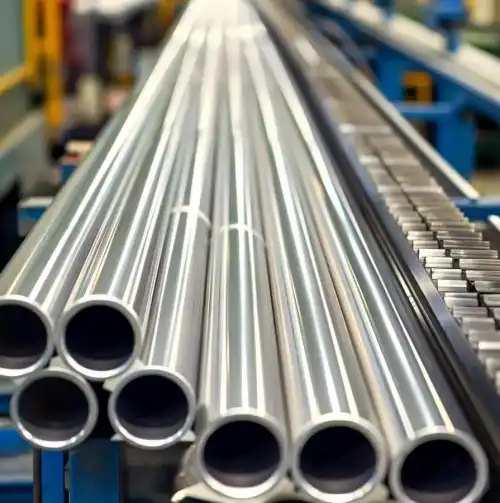
In requesting mechanical settings, a 3 inch titanium pipe is a critical, well-designed portion that has an excellent strength-to-weight ratio, excellent resistance to erosion, and an outstanding lifespan. The ostensible exterior breadth of these precision-machined channels is, as a rule, 3 inches (76.2 mm), and the divider thickness can be anywhere from 0.065 to 0.5 inches, based on the weight needs and the needs of the application. These titanium arrangements are exceptionally valuable in numerous areas, like oil and gas, aviation, chemical processing, marine designing, and control era, since they can stand up to tall temperatures, corrosive situations, and high pressures for long periods of time without losing their structural integrity.
Introduction
In businesses that need unwavering performance in harsh conditions, titanium pipes have become essential parts. The specific dimensions of a 3 inch titanium pipe make it very useful for uses that need the best mix between flow rate and installation flexibility. This detailed guide is for buying managers, engineers, distributors, and OEM clients who need to know a lot about specifications, how they work in the real world, and how to make smart purchases.
Professionals can make smart choices about which materials to use, how reliable the system is, and how much it will cost to run in the long run when they know about the special features and functions of these pipes. Titanium has become the material of choice for important infrastructure projects around the world because of the growing need for lightweight, corrosion-resistant pipe options.
Understanding 3 Inch Titanium Pipe: Specifications and Properties
Technical Specifications and Dimensional Standards
Tough ASTM B338, ASTM B861, and ASME SB-338 standards are used to ensure that titanium pipes are always of good quality and the right size. There are different wall thickness choices for the nominal 3-inch diameter. For industrial uses, Schedule 10 (0.120" wall) and Schedule 40 (0.216" wall) are the most common configurations.
Precision tolerances of ±0.1mm are possible for outer diameter measures when LINHUI TITANIUM makes things. This makes sure that connections don't leak and that the system works at its best. Our vacuum-arc remelted (VAR) ingots make titanium lines that are very uniform in their material and chemical makeup.
Grade Selection and Mechanical Properties
Titanium Grade 2 is still the most common grade for 3-inch pipes. It has a tensile strength of 345 MPa and a yield strength of 275 MPa, making it easy to shape and join. Grade 5 (Ti-6Al-4V) has better mechanical properties and a tensile strength of up to 895 MPa, which makes it perfect for military and aerospace uses that need to withstand high stress.
These pipes have better qualities than just their basic mechanical properties. Because titanium has a density of 4.51 g/cm³, it is about 45% lighter than stainless steel options. It also resists corrosion better in chloride environments, organic acids, and oxidizing conditions up to 600°C.
Quality Assurance and Testing Standards
Every titanium pipe undergoes comprehensive quality verification, including hydrostatic testing, ultrasonic inspection, and dimensional verification. LINHUI TITANIUM's quality control processes ensure oxygen content remains below 0.15% for Grade 2 material, meeting ASTM B338 requirements while providing full material traceability from melt heat number through final inspection.
Practical Applications and Benefits of 3 Inch Titanium Pipes
Oil and Gas Industry Applications
The biggest market for 3-inch titanium pipes is in the oil and gas industry, especially for use in offshore platforms where rust from seawater is a big problem. These lines work great for processing sour gas, where high levels of hydrogen sulfide would quickly break down other materials. PETRONAS has successfully used our titanium piping systems in deepwater gas processing units, which are expected to last for 25 years with little maintenance.
Titanium is very useful for underwater uses because it doesn't crack when exposed to chloride stress corrosion and can keep its mechanical properties in high-pressure, high-temperature conditions. The biocompatibility of the material also stops marine growth from sticking to it, which cuts down on upkeep times and downtime for operations.
Aerospace and Defense Sector Utilization
3-inch titanium pipes are used in hydraulic systems, fuel lines, and environmental control systems because they are very strong for how light they are. Because it doesn't break down easily and stays stable at temperatures between -195°C and 600°C, the material is essential for important airplane systems that need to work well for a long time.
For corrosion protection, military standards often call for NACE MR0175 compliance. Our pipes meet these standards by using controlled chemistry and special heat treatment methods. Titanium is useful because it is not magnetic, which makes it useful in sensitive electronic environments and underwater uses.
Chemical Processing and Marine Engineering
In chemical processing plants, 3-inch titanium pipes are used to carry acidic substances like organic acids, chlorine compounds, and high-temperature process streams. Due to its resistance to pitting, crevice corrosion, and stress corrosion cracking, the material doesn't need expensive coatings or to be replaced all the time.
Desalination plants, marine wind farms, and shipbuilding projects that will be exposed to seawater for a long time need materials that are very resistant to corrosion. The fact that Lukoil used our titanium pipes in sour gas injection systems shows how well the material works in harsh conditions.
Comparing 3 Inch Titanium Pipes with Other Materials and Sizes
Material Performance Comparison
Comparing 3 inch titanium pipes to stainless steel 316L, they show better corrosion protection in chloride environments while also being 45% lighter. Lifecycle cost analysis shows that even though the original costs may be three to four times higher, there are big savings because of less maintenance, longer service life, and not needing protective coatings.
Alternatives to aluminum don't work well at high temperatures or prevent corrosion, which are important for industrial uses. Titanium's 114 GPa elastic stiffness makes it flexible enough to expand with temperature changes while still keeping its shape when pressure changes.
Size Selection Considerations
There are important efficiency trade-offs between 3-inch and 2-inch titanium pipes. It works very well for high-volume uses because the bigger diameter gives 225% more flow area while only adding 50% more weight. Two-inch pipes, on the other hand, are better for installations with limited room and lower material costs for lower flow needs.
Another important factor is installation flexibility. For example, 3-inch pipes need special lifting tools and bigger connection hardware, which can change the logistics of the project and raise the cost of installation. Our engineering team offers full assistance in choosing the best size based on the needs of each application.
Procurement Guide for 3 Inch Titanium Pipes
Market Pricing and Lead Time Management
Titanium pipe prices change based on the cost of raw materials, how hard it is to make, and how many orders are placed. At the moment, Grade 2 pipes cost between $45 and $65 per kilogram on the market, while Grade 5 pipes cost between $62 and $85. Orders that weigh more than 500 kilos usually get a discount.
With two factories and 30 production lines, LINHUI TITANIUM can be flexible with scheduling and cut down on wait times. Standard Grade 2 pipes ship in 4 to 6 weeks, but custom specifications can take 8 to 12 weeks, based on how complicated they are. Our 800-ton yearly capacity makes sure that even big projects can get what they need.
Supplier Qualification and Certification Requirements
The success of procurement rests on choosing suppliers with a wide range of certifications. Some important qualifications are ISO 9001:2015 approval for quality management, ASME certification for use in pressure vessels, and compliance with PED 2014/68/EU for European markets. DNV, SGS, and TUV all offer third-party inspection services that add to the quality guarantee.
As per EN 10204 3.1 guidelines, material certification must include Mill Test Certificates, chemical analysis reports, verification of mechanical properties, and records of dimensional inspections. When oil and gas uses involve sour service conditions, NACE MR0175 compliance documentation is very important.
Company Introduction and Product & Service Information
As a top maker of high-performance 3 inch titanium pipes since 2003, LINHUI TITANIUM has built on 21 years of experience in making things precisely. Our headquarters are in Xi'an, China, which puts us in a good spot along the Belt and Road initiative. This makes it easier to handle the global supply chain efficiently and respond quickly to the needs of international projects.
Our full range of manufacturing services includes two specialized factories with 30 high-tech production lines that can produce up to 800 tons of goods each year and can be scaled up or down to fit any order size. We are experts in titanium alloys from Grade 1 to Grade 12. We can make solutions that meet the exact needs of different industries in terms of pressure, temperature, and corrosion protection.
Quality control is still very important to us, and our ISO/SGS/TUV certifications make sure that every product meets the highest international standards. Our global shipping network uses DHL, FedEx, air freight, and sea freight to quickly send goods to more than 60 countries around the world. Our relationships with PETRONAS, Lukoil, and Siemens Healthineers show that we can provide reliable, high-quality titanium solutions for world-class engineering projects.
Conclusion
Three-inch titanium pipes are becoming more and more important in businesses that need high performance, resistance to corrosion, and long-term dependability. These designed solutions offer a lot of value over their whole life because they require less upkeep, last longer, and work better in harsh conditions where regular materials don't work.
Choosing the right grade, making sure the seller is qualified, and thinking about the total cost of ownership, not just the initial purchase price, are all important parts of a successful procurement. LINHUI TITANIUM is the best partner for companies that need precision-crafted titanium piping solutions that deliver real operational benefits and project success. This is because we have a wide range of manufacturing capabilities, quality certifications, and global supply chain expertise.
FAQ
Q: What are the typical lead times for 3 inch titanium pipe orders?
A: Standard Grade 2 titanium pipes typically ship within 4-6 weeks from order confirmation, while custom specifications require 8-12 weeks, depending on complexity and quantity. Our production capacity of 800 tons annually ensures reliable delivery schedules even for large-scale projects. Rush orders may be accommodated based on current production schedules.
Q: How do 3 inch titanium pipes perform in highly corrosive environments?
A: Titanium pipes excel in corrosive environments due to their natural oxide layer that provides exceptional resistance to chlorides, organic acids, and seawater. They outperform stainless steel in most corrosive applications and maintain structural integrity at temperatures up to 600°C. NACE MR0175 compliance ensures suitability for sour gas service conditions.
Q: What customization options are available for dimensions and grades?
A: We offer comprehensive customization, including wall thickness variations, custom lengths up to 12 meters, and titanium grades from Grade 1 through Grade 12. Special alloys and surface finishes can be provided based on specific application requirements. Our engineering team provides technical support to optimize specifications for your particular application needs.
Partner with LINHUI TITANIUM for Your Titanium Pipe Requirements
LINHUI TITANIUM invites procurement professionals and engineering teams to experience our comprehensive 3 inch titanium pipe solutions backed by 21 years of manufacturing excellence. Our dual-factory configuration delivers precision-crafted pipes with 0.1mm tolerance accuracy, complete certification packages, and reliable global delivery through established logistics networks.
Whether you require corrosion-resistant piping for offshore platforms, high-strength tubes for aerospace applications, or ultra-pure solutions for medical devices, our Grade 1-12 titanium options meet your most demanding specifications. Our dedicated engineering support team stands ready to assist with material selection, custom configurations, and technical consultations to ensure optimal performance for your specific applications. Contact us at linhui@lhtitanium.com to secure your personalized quote within 24 hours and discover why global engineering leaders choose LINHUI TITANIUM as their preferred titanium pipe manufacturer.
References
1. ASTM International. "Standard Specification for Seamless and Welded Titanium and Titanium Alloy Pipes for Condensers and Heat Exchangers." ASTM B338-18, 2018.
2. Boyer, R., Welsch, G., and Collings, E.W. "Materials Properties Handbook: Titanium Alloys." ASM International, Materials Park, Ohio, 1994.
3. Schutz, R.W. and Thomas, D.E. "Corrosion of Titanium and Titanium Alloys in Marine Environments." Corrosion Engineering Section, Timet Corporation, 1987.
4. Peters, M., Kumpfert, J., Ward, C.H., and Leyens, C. "Titanium Alloys for Aerospace Applications." Advanced Engineering Materials, Volume 5, Issue 6, 2003.
5. Craig, B.D. "Handbook of Corrosion Data: Titanium and Titanium Alloys." ASM International, Materials Park, Ohio, 1995.
6. Donachie, Matthew J. "Titanium: A Technical Guide, Second Edition." ASM International, Materials Park, Ohio, 2000.