
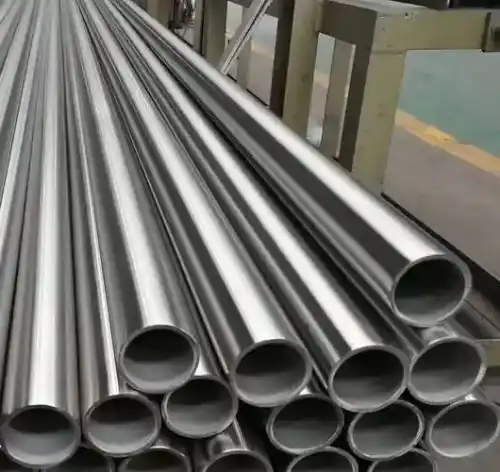
A 3-inch titanium pipe ordinarily has an ostensible diameter of 3 inches (76.2 mm) and a wall thickness that ranges from 0.065" to 0.300" based on the needs of the design. The channels are made according to ASTM B338, B861, or ASME SB-338 benchmarks. They are exceptionally safe to erosion, exceptionally light, and have a pliable quality of 35,000 to 130,000 PSI, based on the review of the titanium you select for your application.
Understanding the Basic Specifications of 3 Inch Titanium Pipes
When looking at titanium pipe determinations, it's vital to know the dimensional parameters so that the work goes easily. The ostensible pipe measure of 3 inches implies that the exterior breadth is 3.500 inches (88.9 mm), but the genuine inner distance across depends on how thick the divider needs to be. Divider thickness is decided by plan numbers from Plan 5S to Plan 80S. These numbers have a coordinate impact on weight evaluations and stream properties.
Chemical Composition and Titanium Grade Classifications
Knowing the contrasts between titanium grades and the chemicals that make them up is an enormous portion of choosing the right fabric. Review 1 titanium is the most safe to rust, but it is moreover the weakest. It is made up of 99.5% unadulterated titanium and exceptionally few alloying components. The most prevalent choice in the commerce world is Review 2, which has awesome erosion security and great formability and weldability.
Grade 5 (Ti-6Al-4V) is the flying machine standard. It has a malleable quality of 130,000 PSI and is made with 6% aluminum and 4% vanadium for improved quality. LINHUI TITANIUM employments vacuum-arc remelted (VAR) ingots in its fabrication prepare. These ingots have an oxygen content of less than 0.15%, which meets the guidelines of ASTM B338 Review 2. This makes it beyond any doubt that all generation clusters have way better fabric judgment.
Mechanical Properties and Performance Characteristics
By knowing the mechanical features of materials, engineers can choose the right grades for tough jobs. The strength-to-weight ratio of titanium pipes is very high. Their density is about 56% that of steel, but their strength is about the same. Temperature tolerance for most grades goes from cryogenic temperatures to 600°F (315°C), which means they can be used in a wider range of industrial areas.
For leak-proof joints, our precision manufacturing keeps a 0.1mm tolerance, and all of our production batches are tested hydrostatically. This strict quality control makes sure that the product always works the same way in serious situations where dependability can't be compromised.
Comparing a 3 Inch Titanium Pipe to Alternative Materials
To choose the right material, you need to carefully compare its performance qualities to those of other piping materials. Titanium piping costs more up front than other choices, but lifecycle value analysis often shows that it is more cost-effective in the long run because it needs less maintenance and lasts longer.
Titanium vs. Stainless Steel Performance Analysis
Even though stainless steel is still a popular material for pipes, titanium is better in many important ways. Titanium is much better at resisting corrosion in chloride environments than stainless steel. This is especially true in naval and chemical processing settings where stainless steel can pit and crack. A weight decrease of about 40% compared to stainless steel means that less structural support is needed and installation costs are lower.
Differences in thermal conductivity also affect how systems are designed. Titanium's lower thermal conductivity makes it naturally insulating. This feature is useful in situations where temperature isolation or energy saving is needed.
Cost-Benefit Analysis for Industrial Applications
Even though 3 inch titanium pipe costs more because it is made of more expensive materials, the total cost of ownership must also take into account how much it saves on upkeep, how long it lasts, and how much more efficiently it works. Chemical processing plants that use titanium pipes say their upkeep costs are 60–80% lower than those that use other materials. This means that the initial investment is recouped within 3–5 years of operation.
Our long-term partnerships with top engineering companies around the world, such as PETRONAS, Lukoil, and Siemens Healthineers, show that we can offer value in a wide range of situations, from ultra-pure materials needed for MRI cooling systems to deepwater gas processing units.
Practical Applications and Installation Guidelines for 3 Inch Titanium Pipes
Titanium pipes are used in many different businesses, and each one needs specific performance qualities that make use of titanium's special properties. Knowing the right way to put something together makes sure that it works well and lasts a long time, while also keeping the material's natural benefits.
Industry-Specific Application Requirements
3 inch titanium pipes are used in hydraulic systems, fuel lines, and pneumatic networks in aerospace. Reducing weight has a direct effect on fuel economy and payload capacity. Titanium's ability to resist corrosion in harsh environments is important for chemical processing businesses, especially those that make chlor-alkali, medicines, and specialty chemicals.
Titanium is resistant to corrosion by seawater, which makes it perfect for use in offshore platforms, desalination plants, and underwater systems. Ultra-pure titanium grades are needed to make medical devices like implantable devices and cooling systems for diagnostic tools.
Installation Best Practices and Maintenance Protocols
The corrosion-resistant properties of titanium are maintained while the structure stays strong when the right welding methods are used. Inert gas shielding keeps things from getting dirty while welding, and the right heat treatment keeps the metal's best qualities. Some of the things that go into joint design are accommodating thermal growth and minimizing stress concentration.
The main goals of maintenance plans are to keep the surface in good shape and look for signs of wear. Regular inspections find problems before they become problems, and the right way to clean keeps the corrosion resistance high throughout the operating lifecycle.
Procurement Considerations for 3 Inch Titanium Pipes
Procurement methods that work well balance the need for quality with the need to meet deadlines and stay within budget. Understanding what the provider can do, what certifications they need, and how to handle logistics is important for making sure the project runs smoothly and reducing the risks associated with procurement.
Supplier Evaluation and Certification Requirements
When choosing a supplier, the factors should put a lot of weight on things like certification compliance, manufacturing capability, and quality control systems. Our ISO/SGS/TUV certifications show that we follow international quality standards. Our PED 2014/68/EU certification lets us follow the rules for the European market. Classification society approvals from DNV, ABS, CCS, and GL show that the product is suitable for naval use.
When it comes to big projects that need to be delivered on time, manufacturing ability is very important. Our yearly production capacity of 800 tons, which is backed by two dedicated factories and 30 advanced production lines, ensures that we can meet the needs of large orders and keep the quality of all of our deliveries high.
Global Logistics and Delivery Optimization
To keep arrival times and transportation costs as low as possible, international shipping needs to be coordinated by someone with a lot of experience in logistics. Our global delivery network uses DHL, FedEx, air freight, and sea freight to find the best delivery times for each project based on its urgency and price.
Mill Test Certificates EN 10204 3.1, NACE MR0175 compliance for oilfield applications, and RoHS 2.0 documentation that ensures regulatory compliance across multiple jurisdictions are some of the documents that are needed for foreign shipments.
LINHUI TITANIUM: Your Trusted Partner for Premium Titanium Pipe Solutions
LINHUI TITANIUM has been making titanium products for 21 years and has built strong relationships with top engineers around the world in the aerospace, energy, and marine industries. Our all-around method combines advanced manufacturing skills with strict quality control to make sure that you always get high-quality titanium pipe solutions that meet the strictest requirements.
Manufacturing Excellence and Quality Assurance
We are very good at making things because we keep investing in new, high-tech production tools and quality control methods. Ultrasonic testing gets rid of inclusion flaws, and full tracking from the melt heat number to the finished pipe makes sure that the quality stays the same throughout the whole production process. Leaders in the field, such as CEFC, PTT, PDVSA, and PETROECUADOR, have praised this dedication to greatness.
Quality assurance is more than just making sure things are safe. It also includes managing certifications and testing procedures. Every shipment comes with full paperwork packages that help meet project compliance standards in all global markets.
Global Market Presence and Customer Success
We do business with more than 60 countries around the world, including those in Africa, the CIS, South America, the Gulf, and Southeast Asia. This wide market presence lets local help happen while keeping quality standards the same all over the world. We have long-term partnerships with well-known EPC contractors that show we can finish difficult tasks on time and to strict standards.
Implementations in PETRONAS deepwater facilities, Lukoil pipeline systems, and Siemens medical equipment are all examples of customer success stories that show how titanium can be used in a wide range of situations that need its unique qualities.
Conclusion
To choose the right specs for 3 inch titanium pipe, you need to know a lot about its dimensions, material grades, and how it will be used. Titanium pipe costs more than other types because it lasts longer and costs less to maintain because it doesn't rust and has a higher strength-to-weight ratio. It can also handle higher temperatures. The project will be completed successfully if the right suppliers are chosen, with a focus on certification compliance, production capability, and global logistics support. With 21 years of experience, strict quality control, and the ability to send products all over the world, LINHUI TITANIUM is the reliable partner that the aerospace, energy, and marine industries need for their tough titanium pipe applications.
FAQ
Q: What is the weight per foot of a 3 inch titanium pipe?
A: The weight varies based on wall thickness and titanium grade. A Schedule 40 3-inch titanium pipe (Grade 2) weighs approximately 3.2 pounds per foot, compared to 7.58 pounds for equivalent stainless steel. Our engineering team can provide precise calculations based on your specific schedule and grade requirements.
Q: How does titanium's corrosion resistance benefit chemical processing applications?
A: Titanium forms a protective oxide layer that provides exceptional resistance to chlorides, acids, and other aggressive chemicals. This eliminates pitting and crevice corrosion common in stainless steel, reducing maintenance costs by 60-80% while extending service life to 20+ years in harsh environments.
Q: What factors influence 3 inch titanium pipe pricing?
A: Pricing depends on titanium grade, wall thickness, length specifications, order quantity, and current market conditions. Grade 2 typically costs 15-20% less than Grade 5, while custom lengths may include processing premiums. Our procurement team provides transparent pricing with quantity discounts for bulk orders.
Contact LINHUI TITANIUM for Your 3 Inch Titanium Pipe Requirements
Ready to source premium 3 inch titanium pipe solutions for your next project? LINHUI TITANIUM combines 21 years of manufacturing expertise with global delivery capabilities to meet your most demanding specifications. Our ISO/SGS/TUV-certified production facilities and 800-ton annual capacity ensure a reliable supply for projects of any scale. Whether you need corrosion-resistant piping for offshore platforms or precision tubes for medical applications, our experienced team provides technical support from specification through delivery. Contact us at linhui@lhtitanium.com today for your personalized quote and discover why global engineering leaders choose LINHUI TITANIUM as their preferred titanium pipe supplier.
References
1. American Society for Testing and Materials. "ASTM B338-18: Standard Specification for Seamless and Welded Titanium and Titanium Alloy Tubes for Condensers and Heat Exchangers." ASTM International, 2018.
2. Boyer, Rodney R. "An Overview on the Use of Titanium in the Aerospace Industry." Materials Science and Engineering: A, Volume 213, Issues 1-2, 1996.
3. Schutz, Russell W. "Corrosion of Titanium and Titanium Alloys in Marine Environments." Corrosion Engineering, Science and Technology, Volume 40, Issue 1, 2005.
4. Peters, Manfred and Christoph Leyens. "Titanium and Titanium Alloys: Fundamentals and Applications." Wiley-VCH Publications, 2003.
5. National Association of Corrosion Engineers. "NACE MR0175/ISO 15156: Materials for Use in H2S-Containing Environments in Oil and Gas Production." NACE International, 2020.
6. European Committee for Standardization. "EN 10204: Metallic Products - Types of Inspection Documents." European Standards Organization, 2004.