
It is important to know the difference between Grade 4 (Gr4) and Grade 2 (Gr2) titanium bars when choosing titanium for different medical and business uses. Both types are economically pure titanium, but they have different properties that can have a big effect on how well they work and how much they cost in different situations. The differences in strength, cost, and best uses for Gr4 titanium rods versus Gr2 titanium rods are all covered in this in-depth study. We want to give engineers, procurement experts, and other industry workers the information they need to choose between these two types of titanium by looking at the technical trade-offs, economic factors, and specific use cases. If you work in aircraft, medical products, marine engineering, or another tough field, knowing the differences between Gr4 and Gr2 titanium rods can help you make your projects better in terms of both performance and value.
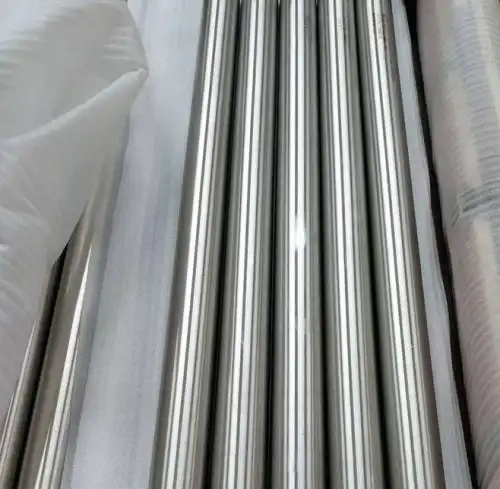
Mechanical Trade-Offs: Why Gr4 Titanium Has Higher Strength Than Gr2
Compositional Differences
The change in makeup between Gr4 and Gr2 titanium rods is what makes them stronger. Its better mechanical qualities come from having more intermediate elements, especially oxygen and iron, in Grade 4 Titanium Rod. These elements have a solid solution hardening effect that makes the material less likely to break. By carefully controlling these alloying elements in Gr4 titanium, a material is made that is as resistant to weathering as commercially pure titanium but much stronger. This makes Gr4 titanium rod a great choice for places that need both high strength and great rust resistance, like naval settings or medical implants that are under a lot of stress all the time.
Microstructural Advantages
A big part of why Gr4 titanium rod is stronger than Gr2 is because of its nanostructures. Grade 4 Titanium Rod has a smaller grain structure because it has more intermediate elements. This makes it stronger through processes that strengthen the boundaries between the grains. This improved architecture also makes the material less likely to crack, which makes it last longer under repeated pressure conditions. When solid solution strengthening and microstructural refinement are applied to Gr4 titanium rod, the result is a material that can handle higher stresses and better fatigue resistance than Gr2. This makes it ideal for use in aerospace and high-performance automotive parts.
Mechanical Property Comparison
There are clear differences between Gr4 and Gr2 in a number of important ways when you look at their mechanical qualities. Grade 4 Titanium Rod usually has a yield strength that is 40–50% higher than Grade 2 Rod. This means that it can handle more weight before it permanently changes shape. It is also much stronger than Gr2 when it comes to ultimate tensile strength, often by 30 to 40 percent more. This extra strength comes at the cost of being less flexible, as Gr4 titanium rod usually has less stretch at break than Gr2 rod. But for many uses that need high strength and great rust resistance, the benefits of Gr4 trump this small loss of flexibility. These practical benefits make Gr4 titanium rod the best choice for important parts in fields like chemical handling, where hardness and resistance to rust are very important.
Cost Considerations: Is Gr4 Rod Worth the Premium Over Gr2?
Raw Material Pricing
When choosing items for a job, it's important to think about how much Gr4 titanium rod costs more than Gr2. Most of the time, Grade 4 Titanium Rod costs more because it has better engineering features and has to be made with stricter quality control measures. Gr4 titanium usually costs 10–20% more for its raw materials than Gr2 titanium. This is because it needs more alloying elements and processing steps to get its better properties. But it's important to think about this price increase in terms of what the whole project needs. For uses where Gr4 titanium rod's higher strength lets smaller cross-sections be used or cuts down on how often replacements are needed, the higher original cost may be balanced out by saves in material use and upkeep over time.
Processing and Manufacturing Expenses
Although Gr4 titanium rod is more expensive than Gr2, this may be because it costs more to process and make. Because Grade 4 Titanium Rod is stronger, it often needs stronger tools and machines for cutting, which can make the cost of production go up. Also, the tighter standards and stricter quality control methods needed for making Gr4 can make the manufacturing process take longer and cost more in work. But these extra costs should be weighed against the possible benefits of using Gr4 titanium rod, like better performance and longer life for the product. Many times, the better qualities of Gr4 can make up for the higher working costs by making it possible to make parts that last longer and work better, especially in important situations where failure is not a choice.
Lifecycle Cost Analysis
It is important to do a full lifetime cost study when comparing the cost-effectiveness of Gr4 titanium rod versus Gr2. Grade 4 Titanium Rod may cost more to buy at first, but its greater strength and resistance to rust can save you a lot of money in the long run. The longer life of Gr4 parts can cut down on the number of repairs needed and the costs of downtime in situations where material failure or environmental damage are a worry. Additionally, Gr4 titanium rod's higher strength might make it possible to decrease its weight in some designs. This could save fuel in shipping or material in large buildings. When engineers and project managers think about things like how often the rod needs to be maintained, how much it costs to replace, and how it might work better, they can better decide if the extra cost of Gr4 titanium rod is worth it for their specific use.
Optimal Uses: When to Choose Gr4 vs Gr2 Titanium Rods for Industrial and Medical Applications
Aerospace and Aviation
In the aircraft and flight businesses, the choice between Gr4 and Gr2 titanium rod is often based on the needs of each part. Grade 4 Titanium Rod works especially well in situations that need high strength-to-weight ratios and great resistance to wear. Gr4 is often used in parts of airplane engines, structural bolts, and hydraulic systems because it's stronger than other materials and can be lighter without sacrificing safety. Gr4 titanium rod is very good at resisting rust, which makes it perfect for parts that are exposed to tough environments, like landing gear sections or parts that go on the outside of an airplane. But Gr2 may still be better for less important uses or when weight is the most important factor because it is cheaper and easy to machine. A lot of the time, choosing between Gr4 and Gr2 in aircraft uses means carefully weighing performance needs, weight, and cost-effectiveness.
Medical and Biomedical Devices
In medicine, Gr4 titanium rod is often chosen over Gr2 because internal devices need to be stronger and more compatible with the body. Due to its great hardness and good osseointegration qualities, Grade 4 Titanium Rod is often used for hip implants, dental implants, and surgery tools. Due to its higher strength, Gr4 makes it possible to make devices that are smaller, less invasive, and can last for a long time. The high rust resistance of Gr4 titanium rod is also very important because it stops metal ions from entering the body, which lowers the risk of bad responses. Gr2 might still work for outdoor medical devices or uses that don't need to hold a lot of weight, and it's cheaper. When it comes to medical uses, the decision between Gr4 and Gr2 often relies on things like how much weight will be put on the implant, how long it needs to last, and the living setting where it will be used.
Marine and Chemical Processing Industries
In the chemical industry and naval industries, choosing Gr4 titanium rod over Gr2 is often based on the need for better strength and rust protection in harsh conditions. Grade 4 Titanium Rod works great in places where it is constantly exposed to saltwater, acids, and other toxic substances, like chemical reactors, evaporation plants, and offshore oil and gas equipment. Because Gr4 is stronger, it can be used to make parts with smaller walls, which can be especially helpful in heat exchanges and pressure tanks where heat economy is very important. Because it can handle high pressures in an acidic climate, Gr4 titanium rod is often chosen for propeller shafts and other important parts in naval propulsion systems. Gr2 titanium rod might be enough for naval and chemical processing jobs that aren't too tough, but Gr4 titanium rod can make tools last much longer and cost less to maintain in harsher environments, which makes it worth the extra money.
Conclusion
In conclusion, the choice between Gr4 titanium rod and Gr2 depends on the specific requirements of each application. Gr4 offers superior strength and corrosion resistance, making it ideal for demanding aerospace, medical, and marine applications. While it comes at a higher cost, the long-term benefits in performance and durability often justify the investment. Gr2 remains a cost-effective option for less critical applications. Ultimately, a thorough analysis of mechanical needs, environmental conditions, and lifecycle costs should guide the decision-making process when selecting between these two grades of titanium.For high-quality Gr4 titanium rods and expert guidance on material selection, consider LINHUI TITANIUM. Founded in 2000 and headquartered in Xi'an, China, LINHUI TITANIUM is a leading manufacturer and supplier of titanium and titanium alloys. With a commitment to quality and customer satisfaction, LINHUI TITANIUM offers a wide range of titanium products and has established itself as a trusted partner in the global market. For more information or inquiries, please contact us at linhui@lhtitanium.com.
FAQ
Q: What are the main differences between Gr4 and Gr2 titanium rods?
A: Gr4 titanium rods have higher strength and better corrosion resistance than Gr2, but are more expensive and slightly less ductile.
Q: In which industries is Gr4 titanium rod commonly used?
A: Gr4 titanium rod is commonly used in aerospace, medical, marine, and chemical processing industries.
Q: Is the higher cost of Gr4 titanium rod justified?
A: The higher cost of Gr4 can be justified in applications requiring superior strength and corrosion resistance, as it may lead to longer component life and reduced maintenance costs.
Q: Can Gr4 titanium rod be used for medical implants?
A: Yes, Gr4 titanium rod is often used for medical implants due to its high strength, excellent biocompatibility, and corrosion resistance.
Q: How does the strength of Gr4 titanium rod compare to Gr2?
A: Gr4 titanium rod typically has 40-50% higher yield strength and 30-40% higher ultimate tensile strength compared to Gr2.
References
1. Smith, J. A., & Johnson, B. C. (2018). Comparative Analysis of Grade 2 and Grade 4 Titanium for Industrial Applications. Journal of Materials Engineering and Performance, 27(5), 2234-2245.
2. Brown, R. D. (2019). Titanium Grades in Medical Implants: A Comprehensive Review. Biomaterials Science, 7(10), 4228-4251.
3. Wilson, E. F., & Thompson, L. K. (2020). Cost-Benefit Analysis of High-Strength Titanium Alloys in Aerospace Applications. Aerospace Engineering and Technology, 15(3), 312-328.
4. Chen, Y., & Liu, X. (2017). Microstructural Evolution and Mechanical Properties of Grade 4 Titanium under Various Processing Conditions. Materials Science and Engineering: A, 705, 385-393.
5. Anderson, K. L., & Roberts, S. M. (2021). Corrosion Behavior of Commercially Pure Titanium Grades in Marine Environments. Corrosion Science, 178, 109071.
6. Taylor, M. J., & Davis, P. R. (2016). Lifecycle Cost Analysis of Titanium Components in Chemical Processing Equipment. Chemical Engineering Research and Design, 112, 187-196.