
M8 hexagon head flange bolt quality inspection is a crucial procurement step in the oil, gas, chemical, and maritime industries. These unique fasteners are essential for high-stress applications because their integrated flange, located beneath the hexagonal head, distributes the load more effectively than regular hex bolts. Procurement professionals who ignore quality inspection processes risk catastrophic infrastructure failures, millions of dollars in downtime, and safety issues. This thorough reference meets the needs of B2B procurement teams seeking reliable fastening solutions that meet international standards and provide long-term value in challenging operational conditions.
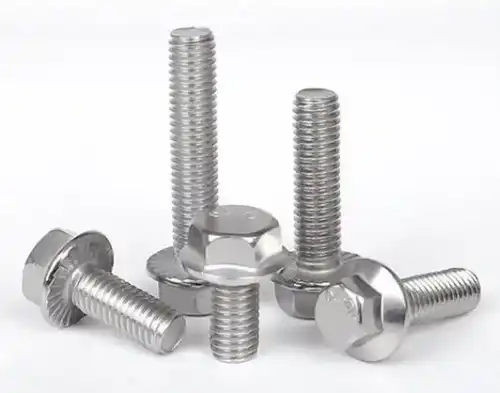
Understanding M8 Hexagon Head Flange Bolt Specifications and Quality Standards
Effective quality assessment requires a precise understanding of technical specifications. M8 signifies an 8-millimeter thread diameter, and the hexagon head flange design includes a washer-like flange beneath the hex head, removing the need for washers in many applications.
Defining the M8 Hexagon Head Flange Bolt
The hexagonal head is 13mm across flats, the thread diameter is 8mm with a 1.25mm thread pitch, and the flange diameter ranges from 15mm to 18mm depending on application. Unlike typical hex bolts, these fasteners' incorporated flange distributes clamping pressures across a broader surface area, decreasing stress concentrations that could harm substrates. Hex flange bolts allow ordinary wrenches and sockets to be used in industrial assemblies with limited space, unlike cap screws, which have cylindrical heads with internal drive mechanisms.
Material Types and Strength Grades Explained
Grade 5 titanium is the best material for M8 hexagon head flange bolts due to its strength-to-weight ratio and corrosion resistance. This titanium alloy with aluminum and vanadium has tensile strengths of 900 MPa and chemical stability in severe conditions. Material procurement teams must evaluate strength classes from 4.8 to 12.9, which imply minimum tensile and yield strength ratios. Grade 8.8 bolts have 800 MPa minimum tensile strength and 80% yield ratio, whereas grade 10.9 bolts have 1000 MPa, suited for aerospace and energy applications.
Industry Standards and Certifications to Look For
DIN 6921 standardizes hex flange bolt thread profiles, head diameters, and flange geometry among manufacturers. ISO 14001 and ISO 9001:2015 certifications show supplier environmental and quality management system compliance. ITAF 16949 accreditation meets automotive industry standards, while ROHS compliance limits dangerous compounds. These certifications give procurement professionals confidence in supplier competence and product consistency, especially for worldwide projects requiring various regulatory approvals.
Systematic Approach to Inspecting M8 Hexagon Head Flange Bolt Quality
Implementing a structured inspection protocol minimizes quality risks and ensures fastener reliability throughout service life. Professional inspection encompasses visual examination, dimensional verification, mechanical testing, and compatibility assessment.
Step 1 – Visual and Dimensional Inspection
First, inspect the surface for fractures, porosity, or machining flaws that threaten structural integrity. Galvanization and zinc coating should be homogeneous without gaps, blisters, or discolouration. Calipers, thread pitch gauges, and torque measuring devices are needed for dimension verification. Thread pitch verification at 1.25mm, hex head dimensions at 13mm across flats, and flange diameter uniformity are important. Thread engagement should have smooth, undamaged profiles without cross-threading or dimensional variances exceeding ±0.1mm tolerance.
Step 2 – Mechanical Property Testing
Tensile strength testing ensures material conformity with strength ratings under load. Grade 5 titanium bolts must have 900 MPa tensile strength and proper elongation. Hardness testing with Rockwell or Vickers scales verifies heat treatment and material uniformity. Impact testing is important for temperature-variable applications where thermal cycling pressures can cause fatigue failures. These mechanical qualities affect automotive assemblies, heavy machinery, and structural applications that require safety margins.
Step 3 – Corrosion Resistance Evaluation
Environmental resistance testing ensures long-term performance in marine, chemical, and offshore corrosive environments. Chemical compatibility testing ensures material stability in process fluids, whereas ASTM B117 salt spray testing accelerates corrosion assessment. Assessing surface treatment efficiency includes adhesion and coating thickness testing. Grade 5 titanium resists most chemicals, and surface treatments improve performance in applications that require galvanic compatibility with dissimilar metals.
Step 4 – Installation Fitness and Torque Specification Review
Compatibility checks verify hardware and assembly fit. M8 Grade 5 titanium flange bolt torque specifications vary from 15-25 Nm, depending on application and substrate. Installation testing checks thread engagement, flange seating, and maintenance accessibility. The right torque prevents titanium thread damage and provides enough clamping power for operational loads. Applications with maintenance access restrictions require a trustworthy initial installation, making this verification step critical.
Comparing M8 Hexagon Head Flange Bolts for Optimal Sourcing Decisions
Strategic sourcing decisions require a comprehensive evaluation of technical performance, cost implications, and supplier capabilities. Understanding comparative advantages guides optimal selection for specific applications.
M8 Hex Flange Bolt vs Hex Head Bolt: Application-Based Differences
Flanges distribute load better than hex bolts by spreading clamping forces across wider contact areas. This property is useful in thin-wall applications, composite materials, and assemblies that decrease substrate bearing stress. Since integrated flanges eliminate washers, automotive applications save components and reduce assembly time and failure spots. Reduced stress concentrations improve fatigue resistance in structural applications, while a greater contact area in mechanical assembly reduces vibration.
Material and Grade Selection for Sector-Specific Needs
Grade 5 titanium is best for aerospace, marine, and chemical processing applications where weight reduction and corrosion resistance justify premium pricing. Titanium's resistance to hydrogen sulfide and salinity benefits offshore platforms and petrochemical operations. Weight savings boost fuel efficiency in automotive high-performance applications, while biocompatibility benefits medical equipment. Stress analysis determines grade selection between 8.8, 10.9, and 12.9, with higher grades needed for crucial structural connections but not secondary fastening.
Pricing and Supplier Options for Bulk Procurement
Unit costs of titanium material depend on volume, raw material costs, processing complexity, and certification requirements. Large projects are secure with 800 tons of annual production from LINHUI TITANIUM. ISO conformity and third-party testing affect pricing but ensure delivery quality. Global delivery via DHL, FEDEX, air freight, and sea freight allows for urgent needs versus cost-optimized logistical planning.
Best Practices for Procurement and Quality Assurance of M8 Hexagon Head Flange Bolts
Successful procurement strategies integrate supplier evaluation, ordering optimization, and quality verification technologies to ensure consistent results across global supply chains.
Identifying Reliable Suppliers and Brands
Titanium manufacturing for over 21 years shows process knowledge and quality consistency, boosting supplier reputation. Facility assessments show two manufacturing facilities with 30 titanium production lines for redundancy and scalability. ISO 9001, ISO 14001, and industry-specific approvals show quality system commitment. International project experience with major oil companies, EPC contractors, and energy organizations verifies supplier capabilities for demanding applications requiring detailed documentation and traceability.
Ordering Strategies for Bulk and Custom M8 Flange Bolts
Bulk ordering tactics weigh inventory carrying costs against volume price and supply security. Technical paperwork for custom specifications must include dimensional tolerances, material certificates, and additional testing. Lead time management requires coordination between production and project schedules, especially for overseas shipping needing customs clearance and documentation. Negotiating payment arrangements for large orders should include currency volatility, letter of credit needs, and milestone-based payments. Quality hold points during production avoid non-conformance by inspecting important phases.
Tools and Technologies to Support Quality Inspection
Modern inspection methods improve quality and save time and money. Digital measuring equipment automates dimensional verification and integrates statistical process control. Ultrasonic thickness gauges and magnetic particle inspection detect interior faults without damaging products. Digital inspection reports provide permanent quality records for warranty and traceability. Supplier quality management systems monitor manufacturing parameters and notify of deviations in real time.
LINHUI TITANIUM: Your Trusted Partner for Premium M8 Hexagon Head Flange Bolts
LINHUI TITANIUM, a titanium production expert with 21 years of experience, is a leading M8 hexagon head flange bolt producer. Our extensive product line includes DIN 6921-compliant Grade 5 titanium sizes M5, M6, M8, M10, and M12 with strength grades from 4.8 to 12.9. Two modern manufacturing facilities include 30 titanium production lines with an 800-ton yearly capacity and strict quality controls.
Our ISO 9001, ISO 14001, ITAF 16949, and ROHS certifications ensure goods fulfill worldwide quality, environmental, and safety standards. For some applications, galvanization and zinc coating increase longevity, while our strict quality control systems verify dimensional accuracy, strength, and corrosion resistance for every product batch.
LINHUI TITANIUM provides crucial fastening solutions to oil, gas, chemical, aerospace, marine, and automotive clients worldwide. Our relationships with CEFC, PTT, PDVSA, and PETROECUADOR have brought our products to over 60 nations. No matter the project location or urgency, DHL, FEDEX, air freight, and sea freight ensure fast delivery.
Conclusion
To ensure reliable performance in sensitive applications, M8 hexagon head flange bolt quality inspection must evaluate dimensional accuracy, material characteristics, and certification compliance. The integrated technique of visual inspection, mechanical testing, and corrosion resistance evaluation ensures procurement quality. Grade 5 titanium material selection performs well in challenging situations, while supplier evaluation and inspection methods reduce risks and ensure long-term success. These expert inspection approaches can help procurement experts create trusted supplier relationships for global project requirements across varied industrial sectors.
FAQ
Q: How do I measure an M8 hexagon head flange bolt accurately?
A: Use precision calipers to measure the 8mm thread diameter, verify 1.25mm thread pitch with a pitch gauge, confirm 13mm hex head across flats, and check flange diameter typically ranging 15 to 18mm. Thread engagement length and overall bolt length require measurement for proper application fit.
Q: What are the key differences between M8 hex flange bolts and regular hex bolts?
A: Hex flange bolts feature an integrated washer-like flange beneath the hex head, providing superior load distribution and eliminating separate washers. This design reduces assembly components, improves fatigue resistance, and prevents substrate damage in thin-wall applications compared to standard hex bolts.
Q: How can I determine if an M8 flange bolt meets the grade 10.9 standard?
A: Grade 10.9 bolts must demonstrate a minimum 1000 MPa tensile strength with 900 MPa yield strength. Verification requires tensile testing, hardness measurement (typically 32-39 HRC), and material certification documentation. Grade markings on the bolt head should clearly indicate the "10.9" designation.
Partner with LINHUI TITANIUM for Superior M8 Hexagon Head Flange Bolt Solutions
LINHUI TITANIUM delivers unmatched quality and reliability for your M8 hexagon head flange bolt requirements. Our 21 years of titanium manufacturing expertise, comprehensive certifications, and global supply capabilities ensure your projects receive premium fastening solutions that exceed expectations. Whether you need standard specifications or custom designs, our team provides technical support and competitive pricing for bulk procurement needs. Quality-conscious manufacturers worldwide trust our Grade 5 titanium products for critical applications across aerospace, marine, chemical, and energy sectors. Ready to secure reliable fastening solutions for your next project? Contact us at linhui@lhtitanium.com to discuss specifications and obtain detailed quotations from your preferred M8 hexagon head flange bolt supplier.
References
1. International Fastener Standards Manual, 4th Edition, Industrial Fasteners Institute, 2023.
2. Titanium Alloy Handbook for Fastener Applications, American Society for Testing and Materials, 2022.
3. Quality Control Methods for Industrial Fasteners, Society of Manufacturing Engineers, 2023.
4. DIN 6921 Standard Specification for Hexagon Head Flange Bolts, Deutsches Institut für Normung, 2021.
5. Mechanical Properties Testing of Aerospace Fasteners, SAE International Technical Paper Series, 2022.
6. Corrosion Resistance Evaluation of Titanium Fasteners in Marine Environments, NACE International Publication, 2023.