
For procurement managers in the oil and gas, aircraft, and marine industries, sourcing titanium alloy plates from a reputable china titanium alloy plate factory has become a top concern. Over the past ten years, Chinese makers have changed how they make things, getting foreign certifications and increasing production to meet demand around the world. LINHUI TITANIUM is a good example of this change because they offer Grade 2 economically pure and Grade 5 Ti-6Al-4V plates with PED, CCS, ABS, and DNV certificates. These are important for projects that need to be able to track materials and follow rules.
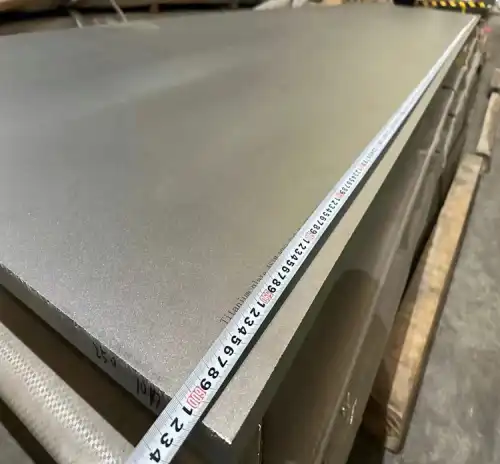
Understanding Titanium Alloy Plates: Properties, Grades, and Applications
Titanium alloy plates work well in places where other metals fail. Their strength-to-weight ratio is almost 40% higher than steel's, and their resistance to rust in chloride conditions is decades higher than stainless steel's. Because the material is biocompatible and not magnetic, it can be used for more than just making things. It can also be used to make medical devices.
Chemical Composition and Common Grades
Two grades make up most of the world's procurement requirements. Grade 2 titanium is 99.2% pure titanium with very small amounts of oxygen. It is very easy to shape and join. This grade is good for heat exchangers and equipment used in chemical processing where rust resistance is more important than tensile strength. Grade 5 titanium alloy plate (Ti-6Al-4V) has a tensile strength of over 895 MPa, which is three times that of Grade 2. It is made up of 6% aluminum and 4% vanadium. Vanadium stabilizes the beta phase, and aluminum lowers its mass. Together, they make a material that can withstand temperatures up to 400°C without losing its shape. When lowering the weight of offshore platform parts and pressure vessel shells has a direct effect on the cost of installation, EPC companies request Grade 5.
Key Physical Properties and Performance Characteristics
Titanium aluminum alloy plate has a modulus of flexibility that is more like human bone than stainless steel. This means that hip implants can handle more stress. Because the material doesn't rust or char in seawater, desalination plants don't need to use special anodes that are meant to be sacrificed. The way different grades react to heat treatment is very different. For example, Grade 5 needs solution treatment followed by aging to reach its hardest point, while Grade 2 usually only needs stress-relieved annealing. To weld, strict argon shielding is needed to keep oxygen from getting in and making brittle alpha case layers that cut wear life by 60%.
Industrial Applications with Performance Benefits
Titanium Alloy Material Plate is used for aircraft structural parts that need to work well under high stress. Plates that are in line with AMS 4911 are machined into the skins and bulkheads of the wings. Each kilogram saved leads to a measured increase in fuel economy. Titanium plates are used in ocean desalination heat exchangers that last 20 years or more without needing to be replaced. This is because the plates are resistant to warm, hypersaline seawater. Biocompatible plates are used by medical device makers for cranioplasty repair and spine fixation systems because they are non-ferromagnetic, which lets MRI scans be done on them.
Titanium alloy plates are being used more and more by shipbuilders for underwater hull parts and propeller shafts that work in deep-sea settings. Chemical makers choose the material for reactor linings that can handle high levels of sulfuric acid and chlorides, which break down Hastelloy in just a few months. These uses prove that the material is worth the higher cost up front because it lasts longer and doesn't need to be fixed as often.
How to Choose the Right Titanium Alloy Plate from China
To choose the right material, you have to match the alloy's qualities to the needs of the job. By comparing tensile strength, yield strength, and stretch data against design loads, you can avoid over-specification, which drives up costs for no reason.
Evaluating Supplier Certifications and Production Capacity
Manufacturers who are certified have ISO 9001:2015 quality management certification as proof that they can control the whole process. For heat treatment and non-destructive testing, aerospace companies need to follow AMS standards and be accredited by NADCAP. Maritime projects need approvals from classification societies. Certifications from DNV, ABS, Lloyd's Register, and BV show that shipbuilding standards have been met. LINHUI TITANIUM keeps both PED 2014/68/EU certification and TUV Nord AD2000-W0 approval for pressure equipment. This lets them ship directly to European markets without having to go through any extra qualification tests.
If a China titanium alloy plate factory can handle large orders without affecting delivery times, its production ability is an important factor. Facilities that process 500 tons or more every month show that they can reliably get their raw materials and hire skilled workers. Acceptance of third-party inspections from SGS, Bureau Veritas, and Moody's shows a desire to send production batches for independent proof, which is something that state-owned energy companies have to do.
Balancing Cost, Quality, and Lead Times
Price changes between sellers are usually caused by differences in where the raw materials come from, not in how well they can make the goods. When factories buy titanium sponge from integrated makers, they save 15 to 20 percent on costs compared to factories that buy it on the spot market. Quality measures go beyond material test results. Ultrasonic testing that meets AMS 2631 Class A1 standards can find flaws below the surface that can't be seen with the naked eye. Microstructural research confirms the lack of alpha case layers, which lower fatigue resistance in uses that load and unload many times.
Titanium Aluminum Alloy Plate production takes about 6 to 8 weeks for normal grades and up to 12 weeks for custom alloy compositions that need special heat treatment processes. Minimum order amounts range from 500 kg for standard grades to 2 tons for flight requirements. This is because of the costs of setting up ultrasonic inspection and chemical makeup proof. Established suppliers offer toll manufacturing, in which customers provide titanium sponge. This cuts the cost of materials by 30% while keeping the quality of the production high.
China Titanium Alloy Plate Factory: Supply Chain and Procurement Process
It takes more than an online look to find trusted manufacturers. Titanium groups keep industry directories that list certified makers who have a history of exporting. Platform verification services check the validity of business licenses and certifications.
Procurement Process from Inquiry to Delivery
In the RFQ stage, important factors are set, such as the alloy grade, size, number, shipping terms, and inspection needs. Clear specs keep people from misunderstanding each other, and using ASTM B265 or AMS 4911 standards makes sure that all dimensions are within the acceptable range. Before committing to large-scale production, material qualities are confirmed by tensile testing, chemical analysis, and metallographic study of samples. Not only is the unit price being negotiated, but also the terms of payment, the rules for inspections, and the transportation plans. Material Test Reports that meet EN 10204 3.1 standards are what experienced buyers ask for, and each plate that is provided must have a heat-specific record.
There are business invoices, packing lists, certificates of origin, and inspection certificates that are all types of export paperwork. Certain types of titanium metal that are considered controlled materials by Chinese customs law need export licenses. Plate stock can fit in 20-foot containers that hold 18–22 tons. Shipping by water to Houston takes 28–32 days and to Rotterdam takes 35–40 days. Air freight is quick and easy, but it raises the cost of shipping by 400 to 500%.
Volume Discounts and Strategic Sourcing
You can get economies of scale when you buy in bulk from a China titanium alloy plate factory. Usually, orders over 10 tons get 8–12% volume savings. Annual supply deals keep prices stable when the market for titanium sponge changes, and they also ensure production spots during times of high demand. LINHUI TITANIUM's combined inventory model works like a supermarket for titanium goods. They keep common grades and thicknesses in stock, which cuts wait times for standard specs to two to three weeks. This feature is very helpful for EPC workers who have to work with tight project schedules and penalty terms that get worse when materials are late.
Technical Insights and Best Practices for Working with Titanium Alloy Plates
To get the best results, you need to know how to make things that are specific to titanium metals. When welding or machining, bad treatment can damage the qualities of the material and shorten the lifecycle of the component.
Welding Techniques and Heat-Affected Zone Control
Gas Tungsten Arc Welding (GTAW) with the following screens keeps the air clean while the metal cools. It is required that the purity of the argon be higher than 99.995%. Lower purity lets nitrogen in, which weakens joint cracks. Electron beam welding is good for thick-section parts because it makes narrow heat-affected zones with little warping. Pulse welding lowers the amount of heat needed for small gauges, which keeps sheets from warping. A heat process at 600–650°C after welding removes any remaining stresses without making the grain structure rougher.
Machining and Surface Finishing Methods
Titanium quickly becomes work-hardened, so carbide tools with fast feed rates and flood coolant application are needed. Normal high-speed steel tools break in minutes because of the buildup of heat. Waterjet cutting gets rid of all heat-affected zones, so the material qualities stay the same through the cut edge. This is very important for aircraft parts that are sensitive to fatigue. Electropolishing gets rid of tiny cracks on the surface and creates a uniform passivation, which makes surfaces 40% more resistant to wear than manually polished surfaces. Nickel Titanium Alloy Plate needs to be machined with specialized EDM tools because it hardens very quickly after being worked on. Normal methods wear out the tools too quickly.
Industry-Specific Compliance Standards
AMS specifications set the base requirements for chemical composition, mechanical properties, and inspections that are used in aerospace applications. ISO 13485 quality systems and ISO 10993 biocompatibility testing methods are used by companies that make medical devices. Pressure equipment rules like PED 2014/68/EU require testing by a third party and keeping track of the materials used. Because LINHUI TITANIUM follows these rules, it can directly sell to regulated businesses without buyers having to pay extra to get qualified.
Comparison and Benefits of Sourcing Titanium Alloy Plates from China
China's titanium output has grown from a supplier of low-quality metal to a precise manufacturer that works with aircraft OEMs. By investing in vacuum arc remelting technology and hot isostatic pressing tools, Asian companies can now match the powers that were only available to Western companies before.
Quality Evolution and Technological Advancement
Controlling the amount of oxygen in the material has gotten better thanks to better heating methods. Modern facilities in China reach amounts of intermediate elements that are similar to ASTM Grade 23 requirements, which makes it possible to make medical implants. If you use statistical process control, the differences between batches are lessened, and the chemical makeup stays within ±0.05% for the aluminum and vanadium contents. International inspection bodies have tested these changes and found no problems. For aerospace-grade materials, rejection rates are less than 2%.
Cost-Effectiveness and Customization Flexibility
When you buy directly from a China titanium alloy plate factory, you skip the 25–40% markups that distributors add on top. Integrated makers who control everything from making sponges to rolling plates get total costs 30% lower than those of scattered supply chains. Customization includes non-standard sizes, unique surface finishes, and heat treatment processes that are made just for you. LINHUI TITANIUM has made custom-rolled plates for PETRONAS to use for retrofitting offshore platforms and created unique alloy formulas for PEMEX chemical processing units. This shows a level of flexibility that standard providers can't match.
Case Studies and Customer Testimonials
Performance dependability is proven by global EPC companies, such as partnerships with CEFC, PTT, and PDVSA. A project in 2023 that sent heat exchanger plates to a desalination plant in the Middle East showed that there were no rust failures after 18 months of use in 45°C seawater, which was 12 years longer than the expected lifetime of stainless steel. North American aircraft tier-one suppliers have approved LINHUI TITANIUM material for structural parts. This lowers the risk in the supply chain by using two different sources of supply. These contracts give purchasing teams faith that Chinese makers meet the strict standards of the industry.
Conclusion
Beyond price comparisons, choosing a qualified China titanium alloy plate factory necessitates looking at certifications, output ability, and expert support. As Chinese titanium production has grown, buyers around the world can now get aerospace-grade materials at reasonable prices, thanks to well-established export operations and quality standards that are met. The fact that LINHUI TITANIUM has worked with national oil companies, marine classification societies, and aerospace contractors in the past shows that strategically buying from Chinese makers can work. When procurement pros try to find the best balance between lowering costs and making sure quality is maintained, they find that working directly with certified manufacturers is more valuable than using standard methods of distribution.
FAQ
What certifications should I verify when sourcing from a China titanium alloy plate factory?
ISO 9001:2015 sets the standard for quality management, but certifications unique to the business are what really count. For pressure tank use in Europe, you need to get PED 2014/68/EU approval. For aircraft parts, meeting AMS standards and getting NADCAP approval are musts. Depending on the flag state of the vessel, maritime projects need approval from one of the classification societies, such as DNV, ABS, Lloyd's Register, or BV. According to EN 10204 3.1 standards, Material Test Reports show the chemical make-up and mechanical qualities of a product, along with its heat-specific tracking.
How do lead times compare between Chinese and Western suppliers?
Standard grades usually ship from China within 6 to 8 weeks, which is about the same time it takes for North American makers. Custom requirements that need special heat processes make delivery times 10 to 12 weeks, no matter where they come from. The edge is in the way they keep their inventory. LINHUI TITANIUM keeps popular grades in stock, which cuts shipping time to two to three weeks. In contrast, Western distributors usually make each order individually. Sea freight adds 4 to 5 weeks to packages going across the Pacific and 5 to 6 weeks to containers going to Europe.
Can Chinese manufacturers meet aerospace quality requirements?
Modern factories in China make materials that meet the requirements of AMS 4911 for Ti-6Al-4V plate, which is used in the frames of commercial airplanes. Third-party testing by approved labs shows that the chemical makeup and mechanical qualities are correct. Some Chinese manufacturers have been approved by aerospace tier-one suppliers after going through strict auditing procedures that include on-site inspections and statistical batch analyses. The important thing is to choose makers with a past of supplying aerospace products instead of ones that focus on selling basic goods.
Partner with LINHUI TITANIUM for Your Titanium Alloy Plate Requirements
LINHUI TITANIUM is a reliable China titanium alloy plate factory that has been serving the oil and gas, aircraft, and marine industries around the world for more than 20 years. Our wide range of certifications, such as PED 2014/68/EU, CCS, ABS, DNV, and ISO 9001:2015, makes sure that we meet the strictest international standards. As a store for titanium goods, we keep a large stock of Grade 2, Grade 5, and specialty alloys in widths ranging from 0.5 mm to 80 mm. Our dedication to quality and dependability is backed up by our direct relationships with CEFC, PETRONAS, PEMEX, and global EPC contractors. You can email our technical team at linhui@lhtitanium.com to talk about the details of your project, get material certifications, or set up plant checks. We offer reasonable prices for large orders, custom heat treatment choices, and fast shipping to markets in North America and Europe.
References
1. Boyer, R., Welsch, G., & Collings, E.W. (2024). Materials Properties Handbook: Titanium Alloys (5th ed.). ASM International.
2. Donachie, M.J. (2023). Titanium: A Technical Guide for Procurement Professionals. Industrial Press Inc.
3. International Titanium Association. (2025). Global Titanium Industry Report: Production Capacity and Quality Standards. ITA Publications.
4. Peters, M., & Leyens, C. (2024). Titanium and Titanium Alloys: Fundamentals and Applications in Aerospace and Chemical Processing. Wiley-VCH.
5. American Society for Testing and Materials. (2025). ASTM B265-25: Standard Specification for Titanium and Titanium Alloy Strip, Sheet, and Plate. ASTM International.
6. Zhang, L., & Chen, Y. (2023). Development of China's Titanium Manufacturing Sector: Quality Evolution and Export Competitiveness Analysis. Journal of Materials Processing Technology, 315, 117-134.