
You need to know about important specs, performance traits, and application needs in order to choose the right ASTM B363 Gr5 titanium elbow for business use. The Ti-6Al-4V material used to make the ASTM B363 Gr5 titanium elbow gives it great resistance to rust and high strength-to-weight ratios that are needed in tough industrial settings. This full guide talks about important choice factors like pressure rates, measurement standards, material values, and industry-specific needs to ensure the best performance in oil, gas, chemical, airplane, and marine uses.
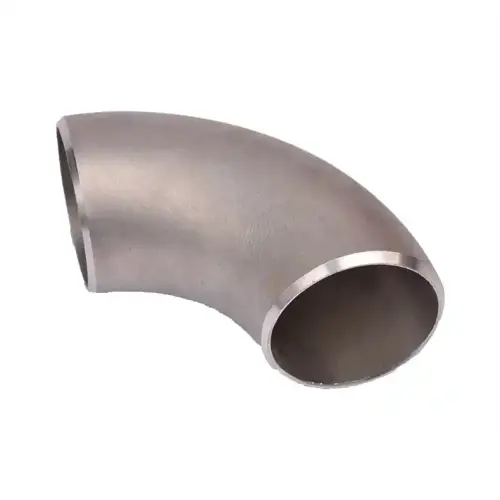
Understanding ASTM B363 Grade 5 Titanium Specifications
Titanium metal parts made to withstand high temperatures and rust are governed by the ASTM B363 standard. Ti-6Al-4V, or Grade 5 titanium, is made up of about 6% aluminum and 4% vanadium, which makes it an alpha-beta metal. With a tensile strength of 895–1000 MPa and a yield strength of 828–950 MPa, this material has amazing mechanical qualities. The standard covers both seamless and welded titanium pipe joints, such as 45° and 90° bends, 180° returns, and special titanium fittings. Tough quality control measures must be followed during the manufacturing process to make sure that the dimensions are correct and the metal is intact. Heat treatment methods designed for Grade 5 titanium improve its microstructural properties while keeping the corrosion-resistant elbow qualities. Chemical composition standards demand exact amounts of aluminum and vanadium, along with controlled levels of impurities. The mechanical qualities are directly affected by the oxygen level, which is usually between 0.13% and 0.20%. To keep the metal from becoming weak, the iron content stays below 0.30% and the hydrogen content stays below 0.015%. These rules for chemical integrity make sure that the system works the same way in all kinds of working situations.
Critical Selection Factors for Industrial Applications
In order to define titanium alloy elbow parts, choosing the right pressure grade is a basic thing to think about. The different grades, which are the highest allowed working pressures at different temperatures, are 150#, 300#, 600#, 900#, 1500#, and 2500#. Increased wall thickness and changes to the physical factors are needed for higher pressure values. Temperature performance skills set ASTM B363 Gr5 Titanium Elbow apart from other elements. From very cold temperatures (cryogenic) to 400°C (752°F), the operating temperature varies without affecting the structure's stability. To keep thermal stress in pipe systems to a minimum, thermal expansion factors stay low at 8.6 × 10⁻⁶/°C. Temperature changes don't affect titanium, which makes it a good material for heat-resistant elbows. Assessing corrosion resistance requires knowing about certain external factors. When titanium is introduced to oxygen, it forms protective oxide layers that withstand chemical attack and heal themselves. Longer lasting than stainless steel options in salt settings, acidic solutions, and seawater uses. Applications of industrial ASTM B363 Gr5 Titanium Elbow in chemical processing plants show decades of dependable service.
Dimensional Standards and Sizing Guidelines
Sizes range from DN15 to DN600 (NPS 1/2" to 24") to meet the needs of a wide range of pipe systems. Dimensional conformance follows the ASME B16.9 standards for butt-welding fits, which ensures that they can be used with current systems. When figuring out wall thickness, you have to take into account the pressure inside, the loads from the outside, and safety factors that are unique to titanium. The center-to-end measurements change based on the standard pipe size and the bend radius. Center-to-end measures for long radius elbows are 1.5 times the standard diameter, while measurements for short radius elbows are 1 times the diameter. When designing a system, the measurements of a titanium elbow must take temperature growth into account. When using titanium elbows in aircraft, weight becomes very important because lowering the mass has a direct effect on efficiency. Grade 5 titanium has a mass of 4.43 g/cm³, which means it is about 45% lighter than steel versions. Lightweight titanium elbow designs allow structures to be optimized without affecting their ability to contain pressure.
Manufacturing Processes and Quality Control
To make a seamless product, titanium billets are first hot forged and then machined to the final size, such as ASTM B363 Gr5 Titanium Elbow. This method gets rid of weld gaps while keeping the metal's features the same all the way through the part. Seamless production works especially well in high-pressure situations where stress builds up quickly and needs to be kept to a minimum. Gas tungsten arc welding (GTAW) and electron beam welding are two advanced fusion welding methods used in welded building. Inert oxygen protection keeps things from getting dirty while titanium elbow welding is being done. Post-weld heat treatment improves the grain and lowers any remaining pressures. Dimensional checking, non-destructive testing, and mechanical proof are all parts of quality control methods. Advanced testing tools, like optical microscopes, spectrometers, and X-ray fluorescence monitors, make sure that the standards set by ASTM are met. Testing the mechanical properties of a material confirms its tensile strength, yield strength, and stretch traits. Hydrostatic testing makes sure that all produced parts are pressure-tight.
Industry-Specific Application Considerations
In oil and gas uses, high efficiency is needed in difficult circumstances. Offshore platforms put pressure vessel parts in saltwater, load and unload them repeatedly, and deal with very high and very low temperatures. The wear strength of grade 5 titanium is very high, and it keeps its structural stability over long periods of time. Titanium works well with drilling fluids and finishing chemicals, which is useful for downhole uses. Chemical production settings have their own problems that need to be solved with special materials. Titanium is perfect for chlor-alkali production plants because it doesn't crack when exposed to chloride stress. Titanium is used in process pipe systems that deal with organic acids, acidic solutions, and high-purity chemicals because it is neutral. Custom-made titanium parts meet the needs of a particular process while keeping the operation clean. When used in aerospace, reducing weight is important without putting safety at risk. Titanium's good strength-to-weight ratio is used in engine parts, hydraulic systems, and structural pieces. Titanium smooth elbow designs get rid of possible weak spots while lowering the total weight of the system. Titanium's ability to bend at low temperatures and prevent thermal shock is useful for systems that handle cryogenic fuel.
Economic Considerations and Lifecycle Value
The initial cost of ASTM B363 Gr5 Titanium Elbow is usually higher than those made of other materials, but the long-term cost savings are often better with titanium. Higher initial costs are balanced out by lower upkeep needs, longer service life, and no more breakdowns caused by rust. The total cost of ownership should take into account the time it takes to build, fix, and update the system, as well as the work that goes into it. Titanium has an infinite shelf life and doesn't corrode in air, which is good for inventory management techniques. Unlike carbon steel options that need protective coats and temperature control, these materials don't need much storage space. When industrial needs are very specific, and the world's production capacity is limited, supply chain dependability becomes very important. Market trends show that more and more developing economies are adopting it as a way to improve their infrastructure. ASTM B363 Gr5 Titanium Elbow is being asked for more and more in desalination plants, chemical centers, and coastal projects. For ongoing repair and growth projects, long-term access guarantees a steady supply.
Conclusion
To choose the right ASTM B363 Gr5 titanium elbows, you need to carefully look at their pressure values, size requirements, and the conditions that are specific to the application. In important business situations, grade 5 titanium is the best choice because it doesn't rust, is stronger than aluminum, and has a history of good performance. By learning about industry methods, quality control measures, and lifetime economics, you can make smart choices that improve system performance while lowering the total cost of ownership. With the help of professional advice from service providers with a lot of experience, activities will go smoothly and reliably for a long time.
Ready to Source Premium ASTM B363 Gr5 Titanium Elbows?
LINHUI TITANIUM stands as your trusted titanium elbow supplier with over two decades of manufacturing excellence. Our comprehensive titanium products supermarket offers WPT1 through WPT23 grades manufactured across 30 dedicated production lines. International certifications, including PED, API, ISO, DNV, ABS, and CCS, validate our commitment to quality and safety standards. Global partnerships with renowned companies like CEFC, PTT, PDVSA, and PETRONAS demonstrate our capability to support world-class projects. Annual production capacity of 800 tons ensures a reliable supply chain support for your critical applications. Advanced testing equipment and rigorous quality control protocols guarantee product integrity and performance consistency. Transform your industrial piping systems with superior titanium alloy elbow solutions engineered for demanding environments. Our technical expertise spans oil and gas, chemical processing, aerospace, and marine applications across more than 60 countries worldwide. Contact us at linhui@lhtitanium.com to discuss your specific requirements and receive detailed technical specifications for your next project.
References
1. American Society for Testing and Materials. "ASTM B363 Standard Specification for Seamless and Welded Unalloyed Titanium and Titanium Alloy Welding Fittings." Annual Book of ASTM Standards, Vol. 02.04, 2023.
2. Boyer, R., Welsch, G., and Collings, E.W. "Materials Properties Handbook: Titanium Alloys." ASM International, Materials Park, OH, 1994.
3. Lutjering, G. and Williams, J.C. "Titanium: Engineering Materials and Processes." 2nd Edition, Springer-Verlag, Berlin, 2007.
4. Donachie, M.J. "Titanium: A Technical Guide." 2nd Edition, ASM International, Materials Park, OH, 2000.
5. Schutz, R.W. and Thomas, D.E. "Corrosion of Titanium and Titanium Alloys." ASM Handbook Volume 13B: Corrosion of Materials, ASM International, 2005.
6. Peters, M., Kumpfert, J., Ward, C.H., and Leyens, C. "Titanium Alloys for Aerospace Applications." Advanced Engineering Materials, Vol. 5, No. 6, 2003.